
Outdoor Fashion Events: A Beginner-Friendly Look At A Waterproof 4-in-1 BSWP Moving Head
We recognize that outdoor fashion events feature a unique visual language of their own. We take runway dynamics, garment textures, architectural surroundings, photography angles, and audience sightlines into full consideration when designing lighting schemes. We adopt LED moving head spots to deliver precise focused accents, avoiding uniform brightness across the entire venue. Furthermore, we regard flexible moving-head lighting systems as a practical learning approach for beginners, helping them understand how beam shape, light contrast, and timing coordinate to shape professional visual effects. At LiGHT SKY, we approach event lighting by considering the relationship between the fixture, the garments, the venue, and the story presented onstage.
Understanding The Visual Needs Of Fashion Events
We start fashion‑event lighting design with garments instead of lighting fixtures. Fabrics absorb, reflect and scatter light in distinct ways, determined by their texture, color and surface finish. Satin materials tend to generate striking highlights, whereas dark matte fabrics require carefully calibrated illumination to preserve their form and fine details.
We find runway width also shapes our lighting strategy. A narrow catwalk may require concentrated coverage along a fixed path, while a larger presentation space benefits from multiple overlapping lighting zones. We create these zones to keep models visually connected to the overall production as they move across the stage.
Audience position adds another variable. Guests seated beside the runway can perceive side lighting very differently from photographers positioned near the front. A useful LED moving head spot setup therefore considers several viewing angles rather than judging the scene from one control position alone.
Creating Contrast Without Losing Detail
Fashion shows often rely on contrast to create atmosphere, but excessive contrast can obscure clothing details. Designers should distinguish between dramatic mood and insufficient visibility. A darker background can make garments stand out, yet the model still needs enough controlled illumination for fabric texture and silhouette to remain readable.
Color selection requires similar restraint. Strongly colored light can alter the perceived appearance of garments, particularly whites, pastels, metallic fabrics, and skin tones. Neutral scenes can therefore provide useful reference points between more stylized sections of the show.
Movement does not have to dominate every cue. A slowly changing position can introduce depth during a transition, while static illumination may be more appropriate during a detailed garment presentation. This balance allows the lighting to support the fashion rather than become the primary subject.
Exploring One Fixture With Multiple Functions
Outdoor fashion events may change rapidly during setup. Runway dimensions, backdrop positions, camera locations, and decorative structures can all shift after technical rehearsals. Having several optical functions available within the same fixture category can make those revisions more manageable.
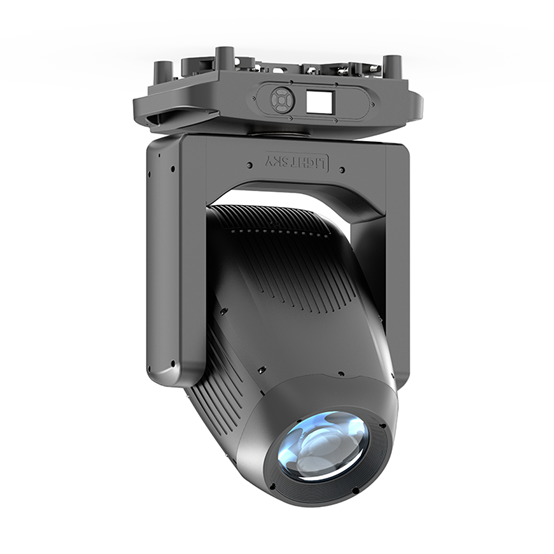
SUPER SCOPE AQUA combines beam, spot, wash, and profile functions in one outdoor-capable unit. Its 520W LED source works across a 3.8°–50° zoom range, while its light frost and heavy frost options can be switched independently and stacked for different levels of diffusion. The fixture also includes a 4-linear prism and 4-facet prism with bi-directional rotation, plus a motorized iris adjustable from 5–100% with a macro function. These features give designers several ways to modify the visual character of a scene without relying solely on color changes.
For beginners, the important lesson is not to use every effect simply because it exists. The 520W LED BSWP 4-in-1 Moving Head format becomes more useful when individual functions are assigned clear purposes, such as broad runway coverage, controlled garment accents, atmospheric transitions, or shaped architectural illumination.
Building Practical Outdoor Cues
Outdoor environments introduce factors that cannot be judged accurately from an indoor rehearsal alone. Ambient light can change after sunset, nearby surfaces may reflect unexpected amounts of illumination, and the apparent intensity of a fixture can shift as viewing distance increases.
We therefore believe cue programming should start with simple lighting states. We first establish the base look, then add movement, color, prism, or iris adjustments only where they deliver meaningful visual value. We find this method simplifies troubleshooting and helps beginners clearly identify which parameter drives each visual change.
A carefully positioned LED moving head spot can also create separation between the runway and surrounding scenery. Rather than illuminating the entire venue uniformly, designers can establish brighter presentation zones and quieter peripheral areas. Such contrast often gives outdoor fashion events a more defined sense of depth.
Making Effects Support The Fashion Story
Every collection may have a different visual character. Minimalist clothing can benefit from clean, restrained illumination, while theatrical collections may support stronger dimensional effects. The lighting vocabulary should reflect those differences instead of applying identical cues throughout the program.
We find prisms work exceptionally well during transitions, as they transform a concentrated light source into multiple visual paths. We see frost filters deliver a distinct effect: their diffusion softens light characteristics and blurs the sharp definition of lighting effects. We also utilize irises for an extra layer of control, as adjusting the iris opening effectively alters the apparent beam shape.
We find the 520W LED BSWP 4-in-1 Moving‑head enables these lighting techniques to coexist within a single lighting system. At LiGHT SKY, we consider such flexibility useful when the creative direction develops during rehearsal, because the lighting team can refine beam character and coverage without rebuilding the entire concept around a different fixture type.
Conclusion
We simplify the logic of outdoor fashion lighting design by treating it as a dynamic dialogue between garments, stage movement, architectural environments, and audience perspectives. We deploy LED moving head spots to deliver precise accent lighting, while leveraging diffusion filters, prisms, iris control, and wide-area lighting coverage to build rich, layered visual effects according to production demands. Instead of overloading every lighting cue with redundant effects, we adopt thoughtful programming to ensure every lighting transition serves a clear purpose and keeps the audience’s focus on the fashion collection. At LiGHT SKY, we adhere to this practical design mindset for outdoor fashion productions. We utilize flexible, high-adaptability lighting tools and intentional cue programming to support creative teams in crafting sophisticated, dimensional, and visually unified outdoor fashion presentation experiences.