
A 4-in-1 Profile Moving Head in Trade-Show Theaters: Ideas for Beam, Spot, Wash and Profile Choices
Trade-show theaters often have to communicate product stories within limited spaces, where lighting needs to support presentations without overwhelming displays, speakers, or brand graphics. Moving head spotlight profile planning can give designers a practical way to shape different zones while keeping the visual language consistent. At LiGHT SKY, we approach this type of environment by considering how each lighting function contributes to the visitor experience rather than treating every fixture as an effects source.
Creating Distinct Zones Within Compact Booths
Trade-show stages rarely have the same depth or infrastructure as permanent theaters. A presentation platform may sit directly beside product displays, while screens, logos, and demonstration areas compete for attention. Careful fixture positioning therefore becomes more important than simply increasing output.
Beam lighting can establish a visual axis above the stage, particularly during entrances or short presentation transitions. Spot projection offers another layer, helping define a presenter or highlight a specific architectural feature without washing the entire booth in the same intensity.
The profile function becomes particularly useful when the stage contains fixed visual boundaries. Shaped beams can frame a presentation position, create clean rectangles on scenic surfaces, or keep unwanted spill away from neighboring exhibits. Such decisions make the lighting plot feel intentional even when the available rigging positions are restricted.
Choosing Optical Functions by Program Moment
Different sections of a trade-show presentation call for different lighting behavior. Product demonstrations may benefit from controlled coverage, keynote speeches generally require comfortable facial illumination, and opening sequences can tolerate more movement or projection.
Rather than assigning one fixture to one visual task, a multi-function approach allows the same position to support several cues. A narrow beam might introduce a speaker, a broader wash can open the stage during a group presentation, and a framed projection may reinforce a particular visual section.
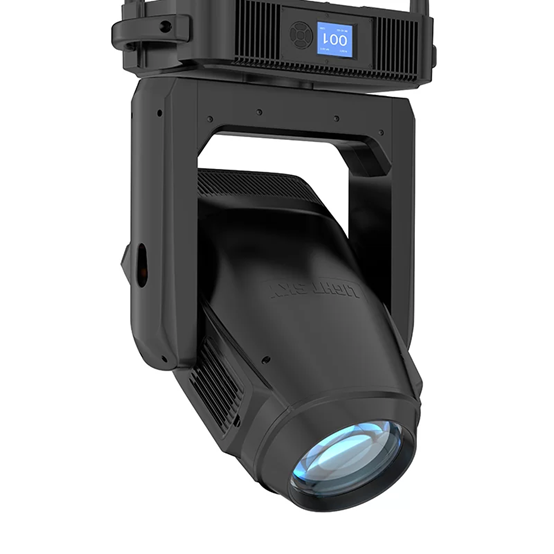
The concept behind LED BSWP 4-in-1 moving head spotlight design is useful here because beam, spot, wash, and profile functions can be considered separately within one lighting strategy. This reduces the need to think of the fixture as having only one permanent role and gives programmers more options when a show evolves during rehearsals.
Understanding a Practical Fixture Configuration
The SUPER SCOPE PLUS is designed for professional indoor stages such as trade-show theaters, with a 41,000-lumen output and a 180 mm precision lens. Its four-in-one architecture combines beam, spot, wash, and profile functions, while the control system supports 43CH and 55CH modes. DMX512, RDM, Art-Net, and sACN protocols provide several options for integrating the fixture into established show-control systems, with 3-pin or 5-pin signal input and output connections.
For a trade-show environment, these control choices can matter just as much as optical specifications. A lighting operator may need to integrate the fixture with an existing console, synchronize cues with presentation playback, or modify parameters during rehearsals. Familiar protocols can make those workflows easier to organize without requiring an entirely separate control architecture.
The framing system also gives designers greater freedom when the stage geometry is irregular. Instead of accepting a fixed circular projection, the operator can shape illumination around screens, scenic panels, or presentation zones. That approach is particularly valuable when several visual elements sit close together.
Balancing Brightness With Audience Comfort
Brightness has a direct relationship with perceived visual hierarchy. Excessive output directed toward the audience can create discomfort, while insufficient separation may cause speakers or displays to lose definition against the surrounding environment.
Trade-show venues also tend to contain substantial ambient illumination. Exhibition halls can include overhead architectural lights, neighboring booths, LED displays, and decorative fixtures, creating a complex background that changes throughout the day.
Consequently, moving head spotlight profile applications benefit from considering contrast rather than brightness alone. A carefully framed area can appear more prominent without raising the intensity across the entire stage. Similarly, subtle background illumination may provide enough depth while leaving the central presentation visually dominant.
Programming Cues That Support Storytelling
Lighting becomes easier to follow when cue changes correspond to recognizable moments in the program. An opening sequence might use movement and stronger contrast, while the main presentation can settle into a calmer state with controlled coverage.
Product demonstrations offer opportunities for more selective transitions. A lighting change can accompany the introduction of a new feature, shift attention toward a physical object, or visually separate one speaker from another. The cue should have a clear connection to the content rather than simply adding motion.
With LED BSWP 4-in-1 moving head spotlight systems, programmers can build these transitions around changes in beam width, framing, color, intensity, and projection. Such flexibility supports different presentation formats while allowing the operator to keep the overall look coherent.
Making the Lighting Plot Easier to Adapt
Trade-show schedules can change quickly. Presentation times may move, speakers can be added, and booth layouts sometimes require last-minute adjustments. A lighting plot that relies on rigid fixture assignments can become difficult to modify under those conditions.
We adopt a more adaptable design that separates essential functions from optional effects. We prioritize speaker visibility, and we only introduce decorative projections and dynamic movements where they add meaningful visual value. We find this approach also maintains stable visual consistency for multi‑day consecutive events.
From our perspective at LiGHT SKY, versatility has practical value when it supports real production decisions. A fixture does not need to perform every available effect in every cue; its broader capability becomes useful when designers need to respond to different stage layouts, presentation styles, or creative requirements.
Conclusion
Trade-show theater lighting works best when every optical decision has a clear purpose. Moving head spotlight profile techniques can define presentation areas, control spill, and add structure to compact stages, while thoughtful programming keeps visual effects connected to the event narrative. Meanwhile, LED BSWP 4-in-1 moving head spotlight solutions can provide several lighting approaches from a unified fixture position, giving designers room to adapt as production requirements change. We at LiGHT SKY focus on this balance between technical flexibility and practical stage‑site application. We help lighting teams build clearer, more adaptable visual environments for professional indoor productions.