Getting More Variety From White Laser Light In Closing Finales
Closing finales carry a different visual responsibility from the opening moments of a show. The audience already understands the atmosphere, so the final sequence needs contrast, timing, and a recognizable visual destination rather than simply more effects. Small laser light can add concentrated movement and definition to selected cues, particularly when the lighting plot leaves enough darker space around the projection. At LiGHT SKY, we carry out this type of design by considering the relationship between fixture behavior, music, scenic elements, and the rhythm of the performance.
Establishing A Visual Language Before The Finale
Every strong ending benefits from preparation. If the brightest effect appears repeatedly throughout the program, its return at the final cue may feel ordinary. Instead, earlier scenes can use softer washes, restrained movement, or limited color so that the closing section has room to develop.
The progression does not need to be complicated. A designer might begin with a broad stage image, introduce directional movement during a musical build, and gradually reduce secondary effects before the final transition. Each change gives the audience another visual reference without overwhelming the main performance.
White laser light can provide a particularly crisp contrast against darker backgrounds. Its visual character becomes more noticeable when the surrounding fixtures are carefully balanced, making beam definition part of the composition rather than simply another layer of brightness.
Creating Contrast Through Movement
Movement is one of the easiest ways to introduce variation, yet continuous motion can quickly become predictable. A sweep that remains unchanged for several minutes may eventually lose its visual significance, even if the beam itself remains bright.
Instead, different sections of the finale can use different movement patterns. Slow horizontal travel may suit a gradual musical build, while a sharper directional change can emphasize a beat or transition. Brief pauses are useful as well because stillness gives the next movement greater visual weight.
A small laser light can take on a focused role within this structure. Rather than moving constantly, it can appear during selected musical phrases and then disappear from the visual field, allowing the audience to notice its return later.
Connecting Lighting With Music
Music provides a natural timeline for visual changes. Crescendos, percussion hits, pauses, and final notes all offer potential cue points, but not every sound needs a lighting response. Too many synchronized actions can make the sequence feel mechanically busy.
A more considered method is to identify the major musical landmarks first. Lighting transitions can then be assigned to those moments, while smaller musical details remain visually understated. This gives the finale a sense of structure without requiring complicated programming.
White laser light can work effectively around these landmarks because a brief appearance or directional shift is easy to distinguish from slower background changes. The strongest result often comes from using fewer major cues and giving each one enough space to register.
Using Software To Shape Performance
Software settings can influence how a lighting fixture behaves during different parts of production. Rehearsals, full-output sequences, and quieter moments may call for different operating priorities, particularly when several fixtures are working together in the same environment.
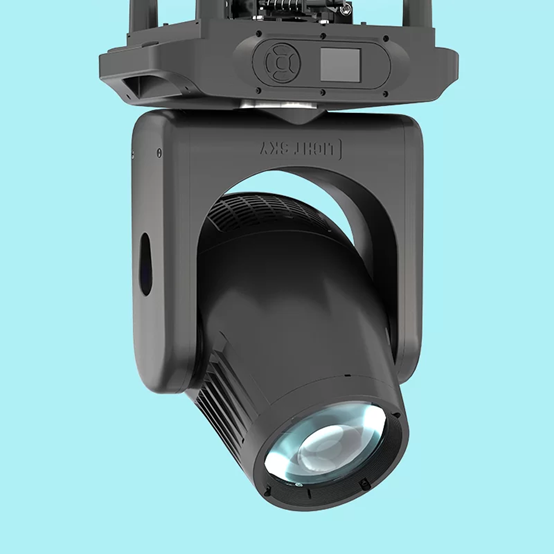
MINI LASER AQUA provides three noise-control modes: High Brightness, Standard, and Silent. It also supports software upgrades through a DMX signal and incorporates intelligent temperature control for the laser source. These functions give production teams additional flexibility when adapting fixture behavior to different operating conditions.
We find such options become more useful when we consider them as part of the cue plan. We at LiGHT SKY treat technical configuration as one element of programming rather than separating equipment behavior from creative decisions.
Balancing Visual Density On Stage
More effects do not automatically create a stronger finale. Screens, performers, scenic pieces, haze, wash fixtures, and moving beams all compete for visual attention, so each component needs enough space to remain readable.
Negative space can be just as important as illumination. A darker section of the stage may frame a performer or screen graphic, while a concentrated beam can occupy another area without forcing every fixture to react simultaneously. This approach creates depth and makes transitions easier to perceive.
The same principle applies to color. Keeping a restrained palette during the buildup allows a later shift to feel more significant. White laser light can then serve as a neutral visual accent within a sequence that otherwise contains saturated colors.
Giving The Final Cue More Character
The closing moment should feel different from what came before it. That difference can come from direction, timing, intensity, color, movement, or even a short pause immediately before the final cue. A blackout followed by a concentrated projection, for example, can create a strong sense of release without requiring a complicated effect sequence.
Another useful technique is to simplify the stage immediately before the ending. Secondary movements can stop, background intensity can fall, and screen content can become visually quieter. The final transition then has a clearer environment in which to appear.
A small laser light works well within this type of arrangement when its appearance has been assigned a specific purpose. It might mark the last musical hit, frame a central screen, or provide movement immediately after the final announcement.
Conclusion
We believe effective closing finales depend on well‑structured visual pacing rather than overwhelming visual quantity. We define a clear purpose for every lighting cue through distinct beam movement, controlled brightness intensity, precise musical synchronization, professional software configuration, and rational utilization of stage space. We deploy white laser lighting strategically to deliver unique visual effects that complement other fixtures, instead of simply repeating or duplicating their functions.
Through practical fixture planning and flexible programming, we at LiGHT SKY consider small laser light as one part of a larger visual composition. A well-shaped closing sequence can therefore feel varied without becoming crowded, leaving the audience with a final image that grows naturally from everything that came before it.