MINI LASER AQUA for Festivals: Where High-impact Beam Moments Can Be Useful
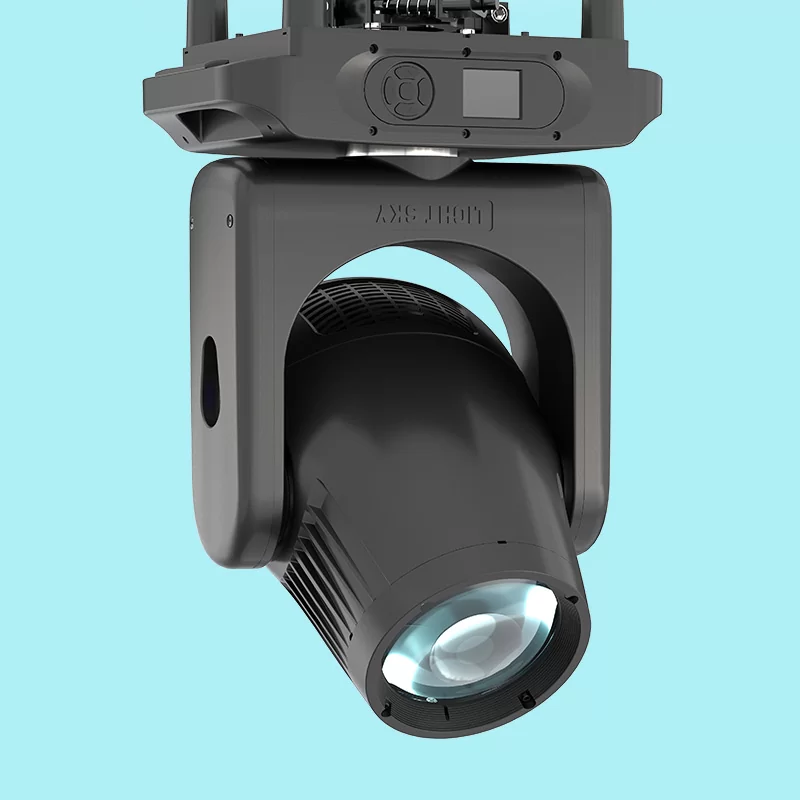
Festival lighting often needs to combine visual definition with practical control. Unlike a fixed indoor stage, an outdoor festival may involve wide viewing areas, changing atmospheric conditions, multiple performance zones, and rapidly changing show cues. At LiGHT SKY, we approach these requirements with MINI LASER AQUA, a compact outdoor laser moving light built around a 100W white laser source, 1.1° beam angle, dynamic color functions, gobo effects, dual prisms, and IP66 protection. These features provide a foundation for considering where concentrated beam effects can contribute to festival lighting design.
What Makes a Narrow Beam Useful at a Festival?
Beam lighting is fundamentally different from general stage illumination. A wash fixture distributes light across a relatively broad area, while a narrow beam concentrates its output into a defined direction. This distinction allows designers to create visible lines and directional patterns that can help connect the stage with the surrounding visual environment.
The beam angle is one of the main factors determining this behavior. A narrower angle produces a more concentrated projection, while wider optics cover a larger area with less directional definition. MINI LASER AQUA uses a 1.1° beam angle and a 128mm optical lens, specifications intended for crisp long-throw projection.
For festivals, this characteristic can be useful when fixtures are positioned at different points around a stage or structure. Instead of relying on broad illumination alone, designers can introduce beams that point upward, across the stage, or toward selected areas of the production environment.
The visibility of a beam is also influenced by the surrounding atmosphere. Haze, fog, and other airborne particles can make the path of a beam more apparent by scattering some of the light toward the audience. Without suitable atmospheric conditions, viewers may see more of the illuminated surface or source than the beam path itself.
How Color Changes Affect Beam Composition
Color is not simply a decorative setting. It can help separate lighting scenes, establish visual contrast, and distinguish one programmed section from another. When a festival program moves between performances or musical sections, controlled color changes can help create transitions without requiring a complete change in fixture position.
A white laser light source provides a defined base for this type of beam treatment. On MINI LASER AQUA, the optical system is paired with a 12-color wheel plus white light and a bi-directional rainbow effect. The fixture also uses a linear CMY subtractive mixing system, giving programmers another method of shaping color.
For practical programming, color changes do not need to happen constantly. A more controlled approach is to reserve stronger transitions for specific cues, such as an artist entrance, a change in musical structure, or a shift between different sections of a festival program.
This also helps maintain visual hierarchy. When every fixture changes color at every cue, the lighting system can become difficult to read. Using beam fixtures selectively allows color to support the composition instead of becoming the composition itself.
Using Gobo and Prism Effects with Beam Lighting
A concentrated beam does not have to remain a simple line of light. Additional optical effects can change how the beam is distributed and perceived. Gobos can introduce patterns, while prisms split the beam into multiple directions and create a more complex visual structure.
MINI LASER AQUA includes a static gobo wheel with 17 fixed gobos plus a white position. It also provides an independent frost effect and both 8-facet and 24-facet prisms, with multiple prism combinations available.
These functions can be considered according to the scale and purpose of the festival area. A gobo may be useful when a patterned projection is required, while a prism can turn one concentrated output into several visual directions.
The important planning point is to match the effect with the scene. A more complex optical effect may be suitable for a transition or special cue, while a clean beam can provide a simpler visual structure during other sections of the performance.
Coordinating Movement Rather Than Simply Adding Motion
Moving-head fixtures add another dimension because the beam direction can change during a programmed sequence. Pan and tilt movement determine where the beam travels, while focus helps maintain the intended optical presentation as the fixture changes position.
A head beam light with motorized movement can therefore become part of the timing structure of a festival show. Slow movement may support a gradual transition, while faster changes can be synchronized with specific cues. The purpose should always be defined by the lighting design rather than by movement alone.
MINI LASER AQUA provides 540° pan and 270° tilt movement, with 8-bit and 16-bit precision options. Its control system supports DMX512, RDM, and Art-Net, allowing the fixture to be integrated into established lighting-control workflows.
This control flexibility matters when several fixture types are operating together. Beam movement can be programmed alongside washes, profiles, effects, and other stage fixtures so that each lighting layer has a recognizable function.
Outdoor Conditions Should Influence Fixture Planning
Outdoor festivals introduce environmental considerations that do not always apply to indoor productions. Rain exposure, temperature changes, installation conditions, and equipment protection all need to be considered before fixtures are deployed.
The MINI LASER AQUA specification lists an IP66 rating and an operating environment of -20°C to 45°C. Its maximum surface temperature is also specified at 80°C. These figures provide useful reference points when production teams evaluate the fixture against the expected operating environment.
Outdoor protection, however, does not replace proper site planning. Mounting positions, power distribution, signal connections, safety equipment, maintenance access, and the expected weather conditions remain important parts of a professional festival setup.
The fixture’s listed factory configuration includes a power cable, signal cable, two safety ropes, and a lamp hook. Optional fly-case packaging is also listed for transport and storage considerations.
Finding the Right Place for Beam Moments
The most useful role for a laser moving fixture depends on the overall lighting architecture. If a festival already contains extensive wash coverage, beam fixtures may be assigned to directional accents rather than general illumination. If the stage design includes large vertical structures, beams may help reinforce their geometry.
Brightness should also be considered together with optics. The product page specifies 350,000 lux at 10 meters, while the narrow 1.1° beam angle concentrates the output into a defined direction. This means fixture placement and aiming remain important when deciding how the output interacts with the stage and audience viewpoint.
Programming should follow the same principle. Beam effects can be particularly useful at selected moments rather than remaining active throughout an entire performance. This gives designers more control over when the audience’s attention is directed toward a particular visual element.
Applying MINI LASER AQUA with a Clear Design Purpose
At LiGHT SKY, we designed MINI LASER AQUA as a compact outdoor laser moving light for stage and entertainment applications. Its 100W laser source, narrow 1.1° optics, color system, gobo wheel, frost, dual prism options, motorized focus, pan-and-tilt movement, and IP66 construction provide a combination of functions for festival environments.