
How AURORA AQUA Helps Build a Cleaner Look in Theatres Through Scene-to-Scene Flexibility
Theatre lighting often needs to change with the structure of a performance. A quiet dialogue, a transition, a group movement, and a more visually active scene may all require different relationships between beam direction, coverage, color, and texture. We find that a flexible lighting approach can help designers make these changes without making the overall stage picture feel unnecessarily complicated.
Why Scene Changes Need More Than One Lighting Approach
A theatrical scene is rarely defined by brightness alone. Designers may need a narrow beam to establish direction, broader coverage to support a larger stage area, or textured projection to add visual definition.
When we plan a lighting system, using separate fixture types for every function can make equipment allocation and programming more complicated. A fixture capable of serving several optical roles can instead provide a practical way to approach different scene requirements within one system.
This is where a 3in1 BSW moving head beam light concept becomes useful. Beam, spot, and wash functions address different lighting purposes, allowing us to consider how one fixture can contribute to several parts of a production.
Beam, Spot, and Wash as Different Tools
Beam lighting is generally associated with concentrated shafts of light and directional emphasis. Spot functions are more suitable when projection, gobo texture, or a defined area needs greater visual control.
Wash lighting serves another purpose by distributing light across a broader area. We do not treat these three approaches as interchangeable because each creates a different relationship between the fixture and the stage.
For theatre planning, combining these functions allows us to consider scene changes as a sequence rather than treating every cue as an isolated lighting problem. This can make fixture allocation and programming decisions more structured.
Optical Range and Visual Transitions
Zoom is particularly relevant when a fixture needs to move between different lighting tasks. A narrow optical angle can concentrate output, while a wider angle can cover more of the stage.
We see the practical value of adjustable optics in how scenes are constructed. Instead of changing the physical fixture position for every visual requirement, designers can use optical adjustment as one part of the cueing process.
A suitable arrangement of moving head light fixtures can also support changes in direction through pan and tilt movement. We need to coordinate movement, zoom, color, and intensity so that transitions remain visually controlled rather than becoming distracting.
Keeping Color and Texture Consistent
Scene-to-scene flexibility also depends on more than beam shape. Color mixing, color-temperature adjustment, gobos, frost, and prism effects can each change how an audience perceives the same stage space.
CMY mixing provides a continuous approach to color adjustment, while CTO can be used when different color-temperature relationships are required. Gobos and frost introduce additional options for texture and softness.
In our approach, these functions should be selected according to the scene rather than used simply because they are available. A cleaner theatrical look often comes from controlled changes instead of adding effects to every cue.
Planning Flexibility Without Overcomplication
A flexible fixture does not remove the need for careful lighting design. We still need to consider mounting positions, throw distances, stage geometry, sightlines, control channels, and the intended visual hierarchy of each scene.
For theatre projects, control compatibility is also part of practical planning. A fixture supporting DMX512, RDM, Art-Net, and sACN can be incorporated into control environments that use these protocols, subject to the wider system configuration.
Our objective is not to make every fixture perform every possible function at once. Instead, we use flexibility selectively so that the lighting system remains understandable while supporting the changing requirements of a production.
A Practical Role for AURORA AQUA in Theatre Lighting
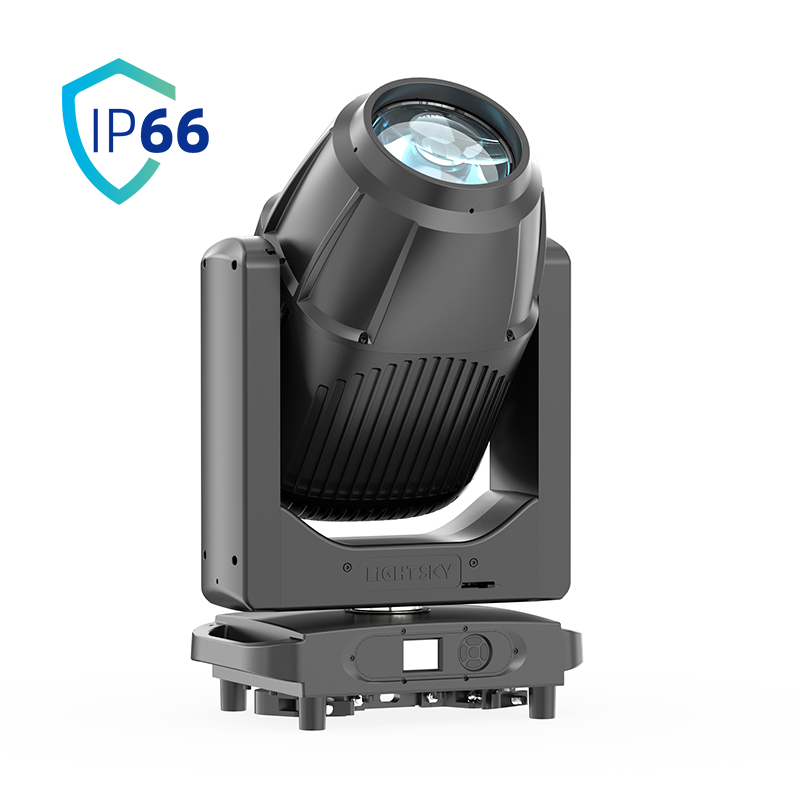
At LiGHT SKY, we designed AURORA AQUA as a 3-in-1 BSW moving head beam light combining beam, spot, and wash functions. Its optical system provides separate zoom ranges for these modes, while CMY mixing, CTO, gobos, prisms, frost filters, and electronic focus provide additional control options. The fixture also uses a 160 mm front lens and supports pan and tilt movement for directional positioning.
For theatre applications, we see this combination as a practical way to approach scene changes with one adaptable fixture platform. Its IP66 construction and stated operating environment of -20°C to 45°C also support projects where equipment may encounter demanding environmental conditions, while its core value for theatre remains its ability to move between different optical roles.
Creating a More Structured Lighting Workflow
Scene-to-scene flexibility works best when we treat it as part of the overall design method. By defining what each scene needs first and then assigning beam, spot, wash, color, texture, and movement functions accordingly, we can avoid unnecessary visual complexity.
For projects considering moving head light fixtures, AURORA AQUA represents LiGHT SKY‘s approach to combining multiple optical functions within one fixture. We can use its beam, spot, and wash capabilities according to the requirements of individual scenes, helping create a lighting workflow that remains adaptable while keeping the visual language of the production coherent.