Making The Most Of A 4-In-1 Profile Moving Head For Conference Keynotes
Conference keynotes ask audiences to absorb information while remaining connected to the speaker, screen content, and overall event atmosphere. Beam moving head light technology can contribute to this balance by adding depth and directional emphasis without turning a business presentation into a theatrical spectacle. At LiGHT SKY, we consider the relationship between stage architecture, presentation content, camera positions, and lighting cues before deciding how much visual movement an indoor conference should contain.
Establishing Focus Around The Speaker
The keynote stage usually has several competing elements: the presenter, presentation screen, logo wall, confidence monitor, and sometimes a product display. Treating these elements equally can flatten the visual hierarchy, so lighting should establish clear priorities from the beginning.
Speaker visibility comes first. Facial illumination needs to remain stable enough for both the audience and cameras, while background effects can provide separation without interfering with slides. This distinction becomes especially important when presentations contain detailed charts, small text, or video sequences.
Stage proportions also influence fixture placement. A wide platform may benefit from several overlapping coverage zones, whereas a narrower conference setup can use more selective angles. Looking at the stage from the audience perspective often reveals whether a beam is adding depth or simply creating another distraction.
Using Direction And Contrast Intelligently
A beam moving head light can create a strong directional element, but its value depends on timing and positioning. Concentrated beams may work well during an opening entrance or transition, while a quieter lighting state generally suits a detailed keynote explanation.
Contrast provides another way to create emphasis. Rather than increasing every fixture simultaneously, designers can allow the presenter area to remain visually stable while changing the background, side light, or architectural illumination. The audience then notices the transition without losing sight of the speaker.
Negative space should not be overlooked. Darker portions of the stage can make selected illuminated areas appear more distinctive, particularly in rooms with large LED walls. This technique also reduces visual clutter when the screen itself contains bright graphics.
Coordinating Color With Presentation Content
Corporate conferences often use established brand colors, yet repeating one saturated hue throughout an entire keynote can make the visual experience feel monotonous. A more flexible approach uses restrained tones for information-heavy sections and introduces stronger color variation during entrances, transitions, or recognition moments.
Color temperature can influence how formal the stage feels. Cooler white tones can suit technology-oriented presentations, while warmer settings may create a more conversational atmosphere. The choice should also account for the appearance of skin tones and physical materials on stage.
We pay extra attention to screen coordination, as screen luminance can shift drastically between presentation slides. Dark on-screen content tends to make our stage lighting look overly bright, while predominantly white slides can lower the overall perceived contrast of the scene. For this reason, we program lighting cues responsively to match real-time screen content, instead of keeping static lighting settings throughout the entire speech segment.
One Indoor Fixture, Several Optical Roles
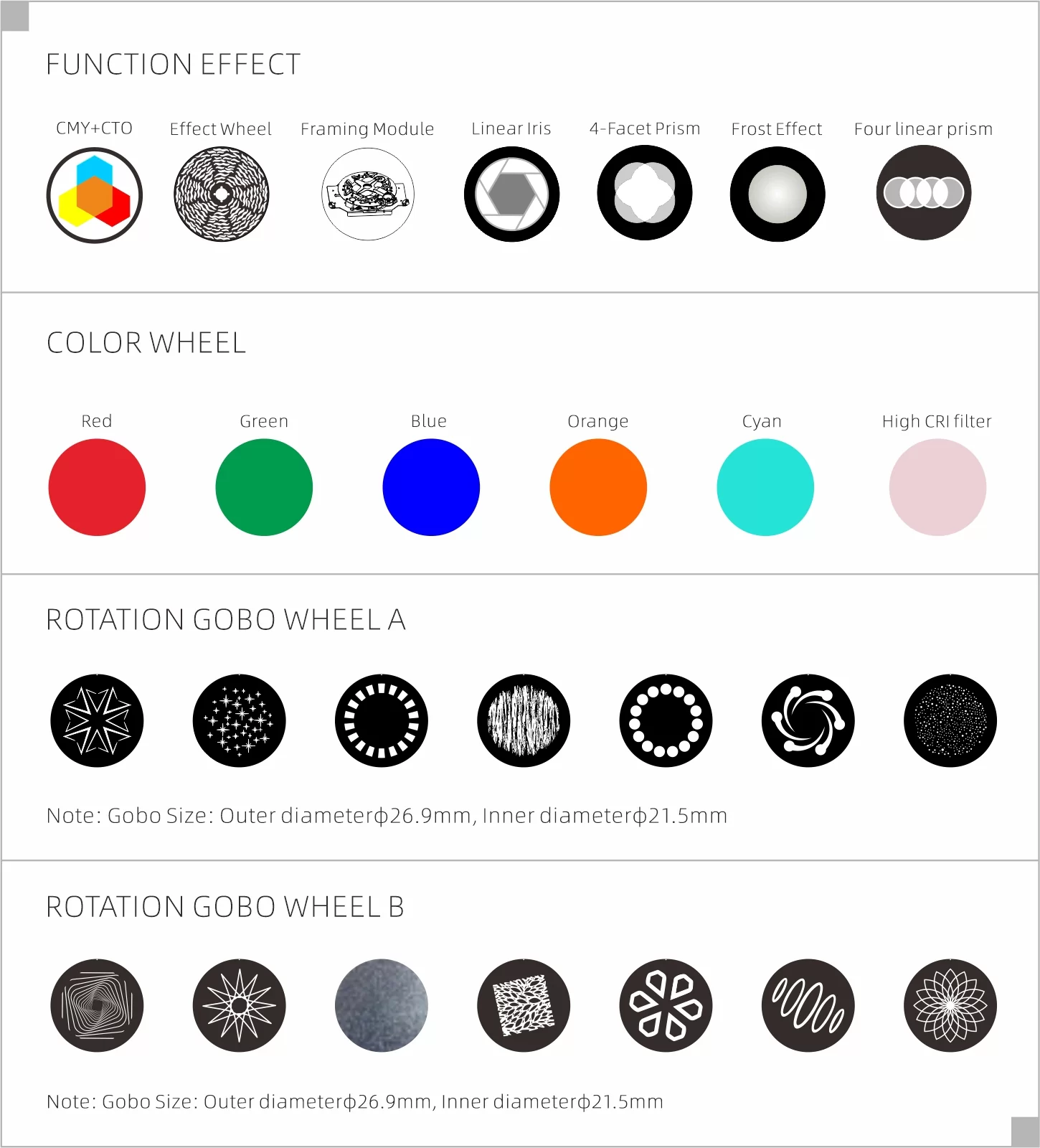
For professional indoor conference productions, we offer SUPER SCOPE PLUS as an example of a multi-function fixture. It combines beam, spot, wash, and profile functions, with a 5-color wheel plus blank and high-CRI filter, infinite CMY mixing, and linear CTO from 2800K to 6800K. Its four-blade framing system provides eight-direction movement per blade with ±55° rotation, while two rotating gobo wheels and an animation wheel add projection options such as interchangeable patterns and flame-style motion.
Building Cues Around The Keynote Story
A conference keynote rarely has one consistent emotional rhythm. The opening may introduce anticipation, the central presentation may require visual restraint, and the closing section might return to a broader, more energetic look.
A LED BSWP 4-in-1 moving head spotlight can support these changes by assigning different optical functions to different sections. Beam effects might accompany an entrance, profile shaping can emphasize selected scenic areas, and wider illumination can support panel discussions or group appearances.
Cue timing should follow the speaker’s actions as closely as practical. A lighting transition that occurs with the appearance of a major presentation graphic can feel connected to the content. An unrelated movement during a technical explanation, however, may pull attention away from the message.
Making Projection Effects More Purposeful
Gobos can introduce texture without requiring constant fixture movement. A subtle pattern projected onto a side wall or scenic surface can give an otherwise simple conference stage greater dimensionality, provided the pattern does not interfere with branding or presentation graphics.
The animation wheel can also be reserved for selected moments rather than used throughout the keynote. Motion has greater impact when it appears as part of a transition, product announcement, or closing sequence instead of becoming continuous background activity.
Framing is equally useful when the stage contains multiple presentation zones. Shaped light can isolate a lectern, discussion area, or demonstration position while leaving neighboring sections visually quieter.
Preparing For Cameras And Multiple Viewpoints
A conference production may be recorded, streamed, or photographed, which means the lighting plot has to work beyond the main audience viewpoint. A beam moving head light can appear balanced from the center of the room but become distracting from a side camera if its beam crosses the lens at an awkward angle.
Technical rehearsals should therefore include camera checks as well as audience checks. Exposure, reflections, screen brightness, and presenter positioning can all affect the final image.
Side seating deserves attention too. Guests positioned away from the centerline may perceive beam paths differently, especially in venues with low ceilings or reflective surfaces. Small adjustments to fixture angle can make the overall environment feel considerably more controlled.
Conclusion
Conference lighting works best when technical flexibility supports communication rather than competing with it. The strength of a LED BSWP 4-in-1 moving head spotlight lies in having multiple optical possibilities available while allowing the designer to decide exactly when each one matters. Thoughtful color, framing, projection, contrast, and cue timing can give a keynote greater visual structure without overwhelming the content. At LiGHT SKY, we use this practical perspective to develop indoor lighting approaches that respect the speaker, the presentation, the cameras, and the audience throughout the event.