
Before Choosing SUPER SCOPE AQUA for Theatres: Think About Framing Basics
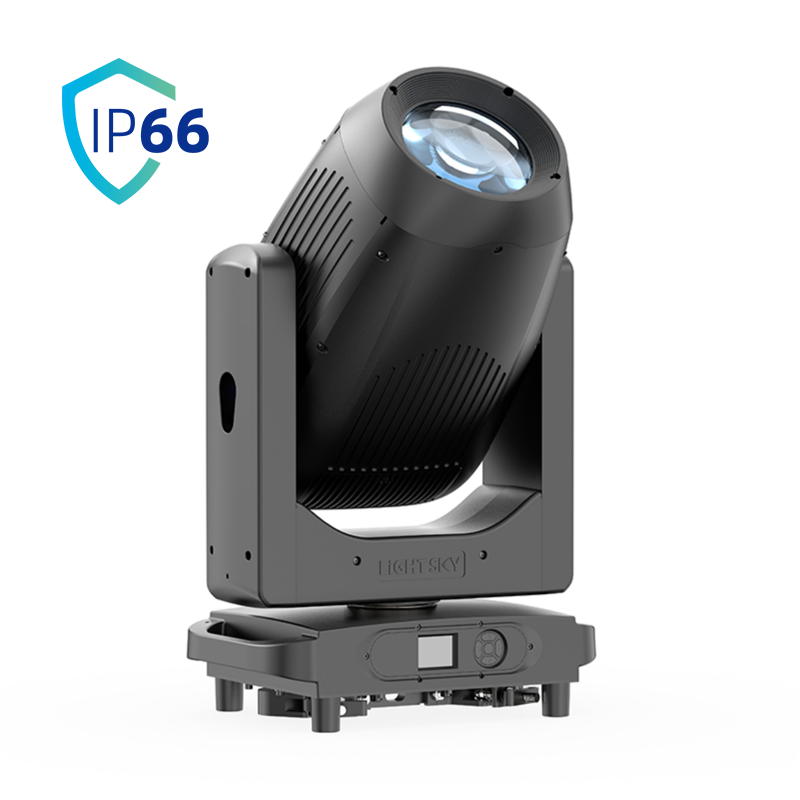
For theatre lighting, fixture selection should begin with how precisely light needs to be placed rather than simply how much output a fixture provides. We at LiGHT SKY approach SUPER SCOPE AQUA from this practical perspective. It combines beam, spot, wash, and profile functions in one waterproof moving head, while its framing system is designed for controlled beam shaping.
Start with the Role of Framing in Theatre Lighting
Framing is essentially the process of controlling the edges of a projected beam. Rather than allowing light to spill onto surrounding scenery, curtains, performers, or set pieces, framing shutters enable designers to define the illuminated area with greater precision.
For theatre productions, this distinction is particularly important because lighting fixtures are often positioned close to architectural elements or scenic structures. A fixture may provide sufficient output, but without effective beam control, part of that light can extend beyond the intended area. The 520W LED BSWP 4in1 Moving head category should therefore be evaluated not only for its light output, but also for the optical control functions that help shape and direct the beam more precisely.
A framing system is particularly useful when designers want to create rectangular or irregular boundaries. The purpose is not simply to produce a visually complex effect; it is to place illumination where it is required while reducing unnecessary spill.
Understand How Four-Blade Framing Works
A basic framing system uses movable blades positioned within the optical path. Each blade can move independently, allowing the operator to alter the shape of the beam. The resulting aperture can then be positioned against scenery, stage areas, or other visual elements.
SUPER SCOPE AQUA uses four independently controllable shutter blades, with the framing module capable of rotating ±90 degrees. This gives the operator two forms of control: adjusting individual beam edges and rotating the overall framing orientation.
When evaluating a commercial lighting manufacturer, we recommend looking carefully at how the framing mechanism is specified rather than treating the presence of shutters as sufficient information. Blade movement, independent adjustment, and module rotation all influence how easily a fixture can adapt to different stage compositions.
Match Framing with Zoom Requirements
Framing does not operate independently from the optical system. Beam angle determines how concentrated or broad the light becomes, while the framing mechanism determines how that light is cut. Considering both functions together makes fixture selection more logical.
SUPER SCOPE AQUA provides a 3.8°–50° zoom range. This covers narrow beam projection through wider wash applications, giving the same fixture different optical roles depending on the production requirement.
For theatre use, a narrow beam can be useful when a concentrated projection is required, while a wider angle can support broader stage coverage. Framing becomes especially relevant when the selected beam needs to be shaped rather than simply widened or narrowed.
Consider Color Before Defining the Final Look
Framing establishes the boundaries of light, but color determines how that shaped light interacts with the stage environment. A lighting plan should therefore consider optical shaping and color control as connected parts of the same design process.
The fixture specification lists CMY color mixing, linear CTO adjustment from 3000K to 7000K, six color filters, and a high-CRI filter. These functions allow operators to adjust color characteristics while maintaining the selected beam shape.
For a commercial lighting manufacturer, the practical question is whether these controls fit the production workflow. Theatre applications can require neutral illumination for one scene and more stylized color treatment for another, so flexible color adjustment can reduce the need to approach every cue as a completely separate optical task.
Look Beyond Framing for Complete Cue Control
Framing is only one part of a moving-head profile fixture. Theatre designers may also need gobo projection, animation, prism effects, frost, iris adjustment, dimming, and strobe functions depending on the production.
SUPER SCOPE AQUA includes rotating and fixed gobo wheels, an animation wheel, linear prism functions, selectable frost, a motorized iris, and electronic dimming. Its dimmer provides linear adjustment from 0% to 100%, while the iris has a stated adjustment range of 5% to 100%.
These functions should not automatically be treated as requirements for every theatre. Instead, they provide a checklist for assessing whether one fixture can cover several planned lighting roles without compromising the specific framing functions that matter to the production.
Check Control and Operational Conditions
A theatre fixture must also fit the control infrastructure already used by the venue. SUPER SCOPE AQUA supports DMX512, RDM, Art-Net, and sACN, with 3-pin or 5-pin XLR connections and dual RJ45 ports.
Operational conditions also deserve attention. The fixture is rated IP66 and specified for an operating environment of -20°C to 45°C. It also provides three fan operating modes, including a silent mode specified at less than 40 dB.
These specifications are relevant when a theatre fixture may also be used outside the conventional indoor stage environment. However, venue requirements should still be checked individually rather than assuming that one protection rating or operating mode fits every installation.
A More Practical Way to Evaluate a Profile Fixture
Before selecting a framing-capable moving head, we suggest working backward from the lighting plan. Identify the stage areas that require controlled edges, determine the expected projection distances, and then consider zoom, framing rotation, color, dimming, and control compatibility.
This approach prevents output figures from becoming the only selection criterion. A fixture can be powerful yet unsuitable for a particular cue structure if its beam cannot be shaped or controlled in the required way. Conversely, a multifunction fixture becomes more useful when its optical features correspond directly to actual production requirements.
Bringing the Selection Process Back to SUPER SCOPE AQUA
For theatres considering SUPER SCOPE AQUA, we see its main relevance in the combination of four lighting functions with dedicated framing control. The fixture uses a 520W white LED module, a 3.8°–50° zoom, four independently controllable framing blades, and a ±90° rotating framing module.
At LiGHT SKY, we position SUPER SCOPE AQUA as a waterproof 4-in-1 BSWP moving-head fixture for applications including theatres, touring productions, TV studios, outdoor events, and large venues. Its specifications provide a practical basis for evaluating whether its framing, optical, color, control, and environmental functions match a specific theatre’s production requirements.
The most useful starting point is therefore not the fixture’s headline output, but the actual shape and position of light required on stage. By examining framing capability alongside zoom, color control, effects, programming protocols, and operating conditions, lighting teams can make the selection process more structured and technically grounded.