A Practical Starting Point for Dramatic Beam Cues in Theatres with MINI LASER AQUA
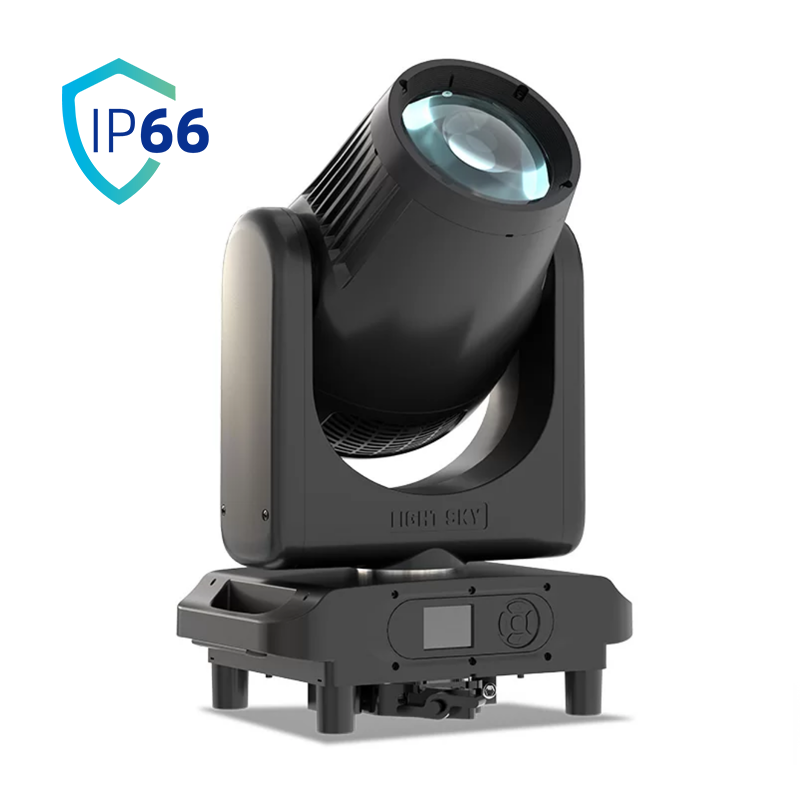
Theatre lighting often needs to shift between subtle stage visibility and clearly defined visual accents. Beam effects can help establish a change in atmosphere, emphasize a transition, or add structure to a larger lighting composition. For these applications, we at LiGHT SKY offer the MINI LASER AQUA as a compact laser moving light designed for outdoor stage and entertainment applications, combining a 100W white laser source with narrow-beam optics, color effects, gobos, prisms, and IP66 protection.
Start with the Role of a Narrow Beam
A beam becomes visually distinctive when its light is concentrated into a relatively small angle. The narrower the beam, the more clearly its path can be defined when suitable atmospheric conditions are present. This makes beam fixtures different from broad wash fixtures, which are generally intended to distribute illumination across a wider area.
The optical design should therefore be considered before selecting effects. A fixture using white laser light can provide a concentrated source for beam-based looks, while the beam angle determines how tightly that output is projected. MINI LASER AQUA specifies a 1.1° beam angle and a 128mm HD optical lens, providing a technical basis for narrow-beam projection.
For theatre programming, this distinction is useful because a narrow beam does not need to illuminate the entire stage to become part of the visual composition. Instead, it can be positioned as a defined accent within a wider lighting system.
Separate Beam Movement from Beam Effects
Movement and optical effects serve different purposes. Pan and tilt determine where a beam travels, while color, gobo, prism, focus, and frost influence how that beam appears. Treating these functions separately can make cue programming easier to organize.
MINI LASER AQUA provides 540° pan and 270° tilt movement, together with motorized focus and linear dimming from 0 to 100%. Its effect section also includes an independent frost effect and two prism options.
A theatre programmer can therefore build a cue in stages rather than relying on one effect to create the entire look. A basic movement cue can establish direction first, followed by color or gobo changes when the scene requires greater visual definition.
Use Color as a Cue Structure
Color is not simply a decorative choice in stage lighting. It can also help distinguish sections of a performance, separate visual layers, or create a controlled transition between cues. The important consideration is how color changes interact with movement and intensity.
A white laser light source provides the base from which colored beam effects can be developed through the fixture’s optical system. MINI LASER AQUA incorporates a 12-color wheel plus white light and a bi-directional rainbow effect, while its specifications also list linear CMY subtractive mixing.
For programming teams, this gives several ways to approach transitions. A single color can maintain continuity, while gradual color movement can accompany a scene change. The choice should remain connected to the production’s visual language rather than adding effects simply because they are available.
Add Gobos When Beam Definition Needs Structure
Beam effects do not always need to remain as plain lines of light. Gobo projection can introduce recognizable patterns and break up the beam visually. This can be useful when the design calls for texture without turning the fixture into a general-purpose wash.
MINI LASER AQUA uses a static gobo wheel with 17 fixed gobos plus one white position. This type of arrangement allows programmers to select specific patterns and incorporate them into repeatable cues.
For theatre applications, restraint is often useful. A gobo can support a transition or visual motif, but excessive pattern changes may compete with performers or scenic elements. The fixture’s capabilities are therefore most useful when each effect has a defined role.
Consider Control and System Integration
A moving fixture becomes more practical when its control system fits into the existing lighting workflow. Theatre installations commonly require repeatable cues, predictable addressing, and straightforward communication between lighting control equipment and fixtures.
MINI LASER AQUA supports DMX512, RDM, and Art-Net protocols, with 17-channel and 19-channel control configurations listed on its specification page. It also uses locking 3-pin or 5-pin XLR DMX/RDM connectors.
For a commercial lighting supplier, this type of control information is important during system planning because fixture selection involves more than optical output. Compatibility with the control infrastructure, available channels, connectors, and programming workflow should all be reviewed before deployment.
Check Environmental Requirements Before Installation
Theatre fixtures may be used indoors, outdoors, or in temporary environments depending on the production. When equipment is exposed to weather, moisture and dust protection become part of the specification rather than optional considerations.
MINI LASER AQUA carries an IP66 rating and lists an operating environment of -20°C to 45°C. The fixture also includes intelligent temperature control and selectable high-brightness, standard, and silent operating modes.
These specifications should be assessed against the actual installation conditions. IP protection does not remove the need for appropriate electrical installation, mounting, safety procedures, and operational planning.
A Clearer Approach to Beam Cue Programming
A useful beam cue normally begins with purpose rather than effect selection. First, determine what the beam should emphasize. Next, establish its position and movement. Color, gobo, prism, focus, and intensity can then be introduced according to the visual requirement.
This sequence also makes troubleshooting more straightforward. If a cue feels too busy, individual effect layers can be reduced without rebuilding the entire sequence. If the beam lacks definition, programmers can examine positioning, focus, atmospheric conditions, and beam angle separately.
For production teams, this approach creates a clearer relationship between equipment capability and artistic intent. Beam fixtures work most effectively when their technical functions are treated as controllable components within the wider lighting design.
Bringing the Approach into Theatre Production
At LiGHT SKY, we position MINI LASER AQUA as a compact laser moving light for stage and entertainment applications. Its 100W laser source, 1.1° beam angle, color wheel, gobo system, dual prisms, movement range, control protocols, and IP66 construction provide several technical options for beam-oriented lighting designs.
For theatres considering a focused starting point for dramatic beam cues, we recommend evaluating the fixture according to the actual cue structure, venue conditions, control system, and required visual functions. This keeps equipment selection grounded in production requirements while allowing MINI LASER AQUA to serve as one practical component within a broader lighting system.