
Wide Stage Backdrops Planning: A Straightforward Use for White Laser Light
Wide stage backdrops can easily become visually flat if the lighting only covers performers and leaves the rear of the venue underused. White laser light offers another way to shape large scenic surfaces, especially during opening images, transitions, and music-driven moments. Rather than filling every section with identical brightness, thoughtful beam placement can create depth, direction, and contrast across a broad backdrop. At LiGHT SKY, we approach this kind of design by considering the relationship between fixture position, surface texture, audience sightlines, and the timing of each cue.
Creating Depth Across Large Backdrops
A wide backdrop does not necessarily need uniform illumination from edge to edge. Dividing the surface into visual zones can make the stage feel deeper without adding excessive equipment. Narrow beams placed at different angles can cross behind performers, while softer sources keep important scenic elements readable.
The distance between fixtures also affects the perceived rhythm of the background. Closely spaced beams create a dense visual texture, whereas wider intervals leave deliberate areas of darkness. Such negative space can be particularly useful during quieter sections, allowing a later lighting change to feel more significant.
Another consideration is the backdrop material itself. Matte scenic fabric tends to produce a softer appearance, while reflective surfaces can make beams appear sharper and more pronounced. Before programming cues, lighting teams should test the actual material under show conditions rather than relying only on specifications.
Using Beam Direction With Greater Precision
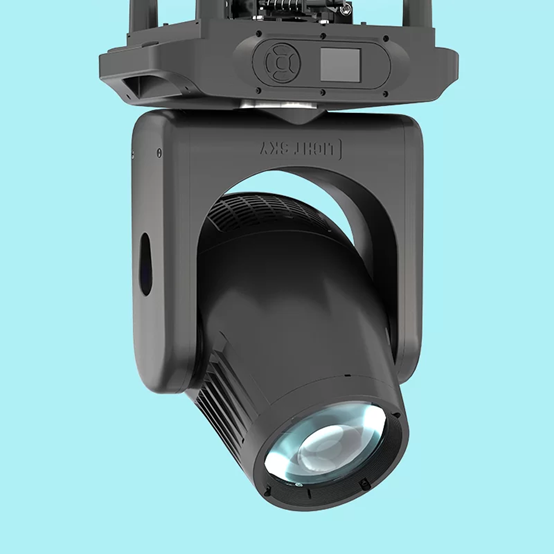
Our mini beam moving head can contribute to this approach when compact fixtures need to occupy positions without visually overwhelming the stage structure. Directional movement allows the same unit to create different compositions throughout a program, although programming should remain intentional rather than simply filling every transition with motion.
Pan and tilt changes can establish visual pathways across a wide background. A slow diagonal movement may complement an entrance, while a short positional change can punctuate a musical accent. The most effective motion usually has a clear relationship with the performance instead of functioning as decoration on its own.
Beam height deserves equal attention. Fixtures aimed too close to eye level may compete with performers, whereas higher angles can create layered lines behind the action. Designers should also account for camera positions, because a beam that looks balanced from the audience may appear disproportionately strong through a broadcast or event camera.
Building Contrast Without Visual Clutter
Contrast does not depend solely on brightness. Color temperature, beam density, movement speed, and empty space can all change how a backdrop is perceived. A restrained white beam against a darker scenic field may appear more dramatic than numerous overlapping effects.
The use of white laser light becomes particularly interesting during moments that require visual clarity. White output can work as a neutral reference within a larger lighting composition, separating colored washes from darker scenic areas. Rather than continuously displaying the effect, designers can reserve it for selected cues so that its appearance retains visual meaning.
Cue timing should follow the structure of the event. During an introduction, restrained movement may establish anticipation; once the main performance begins, stronger geometry can expand the perceived scale. Near the end, reducing movement and leaving a few defined beams can provide a cleaner visual resolution than adding another layer of effects.
Making Programming Easier to Read
Large stages often involve numerous fixtures, so organization inside the lighting console matters as much as fixture capability. Groups based on stage position, movement direction, or visual function make programming more manageable. Naming conventions should also reflect practical roles rather than relying solely on fixture numbers.
For designers working with several beam positions, preset palettes can help maintain consistency. A few carefully prepared movement ranges, focus positions, and intensity states are usually more useful than dozens of nearly identical cues. This approach also makes last-minute adjustments less disruptive when the stage layout changes.
Technical planning should leave room for refinement during rehearsal. Performers may occupy more space than expected, scenic pieces can alter sightlines, and cameras may require different angles. Building flexible cues allows the lighting operator to respond without rebuilding the entire show file.
Balancing Equipment, Space, and Audience View
Fixture placement should begin with the physical limits of the venue. Ceiling height, truss locations, backdrop dimensions, access routes, and audience seating all influence the final composition. A visually attractive idea on paper may become ineffective if the available mounting points force beams into unwanted positions.
Power and control planning deserve attention as well. Compact fixtures can simplify physical arrangements, while appropriate DMX or network distribution helps keep cue response predictable. Signal paths should be checked before programming so that technical problems do not become visible during rehearsal.
At LiGHT SKY, we take practical workflow into consideration alongside visual design. In our work, equipment selection is tied to the intended scene rather than treated as an isolated specification exercise. The goal is to give designers enough control to reshape the backdrop while keeping the overall system understandable and manageable.
Conclusion
Wide backdrops become more expressive once lighting is treated as part of the scenic composition rather than simply an illumination layer. Mini beam moving head fixtures can provide positional flexibility, while carefully timed beams help define scale, rhythm, and depth without overcrowding the visual field. White laser light can then serve as a focused element within that larger language, particularly where clean lines and strong contrast are useful. At LiGHT SKY, we value this balance: thoughtful programming, realistic venue planning, and selective use of effects can transform a large‑scale background into an active element of the performance, without making the setup unnecessarily complicated.