
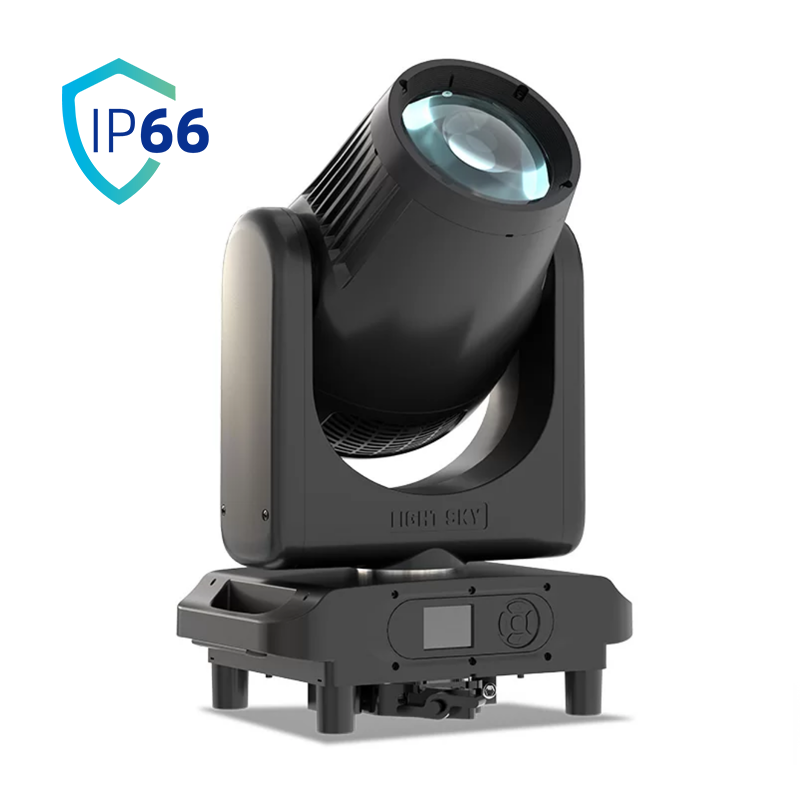
When MINI WHALE Makes Sense for Nightclubs: Focus on Compact Moving-Beam Effects
Nightclub lighting often needs to balance visual movement, fixture placement, control flexibility, and practical installation requirements. For spaces where beam effects are important but fixture size must remain manageable, a compact moving-beam design can provide a focused approach. At LiGHT SKY, we developed MINI WHALE around this type of application, combining a compact moving-head format with beam, color, gobo, prism, and IP66 protection features for nightclub and dynamic event environments.
Why Beam Angle Matters in Nightclub Lighting
Beam angle directly influences how a moving light presents its output in a venue. A narrow beam concentrates light into a defined projection, making it easier to create visible shafts when atmospheric conditions allow. The MINI WHALE uses a 1.3° beam angle, while its optical system also provides narrower configurations through its specified beam options.
For nightclub designers, this type of optical characteristic can be useful when fixtures are positioned above a dance floor, around a stage, or along architectural structures. Rather than relying only on broad illumination, narrow-beam fixtures can contribute directional movement that complements other lighting layers.
The choice of beam angle should still follow the room layout, fixture distance, haze conditions, and desired visual composition. A narrow beam is not automatically suitable for every position, so lighting plans should consider how the output will interact with the surrounding space.
Compact Movement for Flexible Fixture Placement
Physical size can influence how lighting equipment is integrated into a nightclub. Ceiling structures, trusses, stage positions, and available mounting points can all limit where fixtures can be installed. A compact moving-beam format can therefore provide another option for planners working within constrained layouts.
MINI WHALE is specified at 344 × 238 × 601 mm with a net weight of 22.1 kg. Its pan movement reaches 540° and tilt reaches 270°, with 8-bit/16-bit precision movement. These specifications provide a practical reference when evaluating placement and movement requirements.
Movement performance should be considered alongside the fixture’s intended role. A beam unit can be positioned to create directional effects, while other fixture categories can handle wash, general illumination, or more detailed framing duties. This division can help create a more structured lighting system.
Color, Gobo, and Prism Effects Add More Control Options
Beam effects do not have to depend on movement alone. Color and optical effects can change how a fixture contributes to a lighting sequence. The MINI WHALE includes a 14-color wheel plus blank, a bidirectional rainbow effect, and dual-color stepping gradient functions.
Its static gobo system provides 17 fixed gobos plus blank, while the optical effects include independently rotating 8-facet and 24-facet prisms. Motorized focus, independent frost, adjustable pulse strobe, and linear dimming from 0 to 100% are also specified.
These functions can be useful when nightclub programming requires several visual treatments from one fixture type. Designers can use movement for directional changes, gobos for patterned projection, and prisms for beam multiplication. The actual combination should depend on the programming concept and the role assigned to each lighting position.
Where Waterproof Protection Becomes Relevant
Nightclubs are generally associated with indoor environments, but lighting equipment may also be used in outdoor entertainment areas, open-air venues, or locations where exposure to moisture is a consideration. This is where protection specifications become relevant to equipment selection.
A waterproof moving head light should be evaluated according to its stated protection rating rather than assumed environmental capability. MINI WHALE carries an IP66 rating and is specified for an operating environment of -10°C to 40°C.
IP protection does not replace the need for correct installation, handling, and operating conditions. For professional projects, planners should compare the fixture’s environmental specifications with the actual location and installation requirements before deployment.
Control Compatibility and System Planning
A nightclub lighting system normally involves multiple fixtures and control functions, so communication compatibility is another consideration. The MINI WHALE supports 15 control channels, DMX512 and RDM protocols, with ArtNet available as an option. DMX and RDM connectors are offered in 3-pin or 5-pin XLR configurations.
These options allow system designers to consider the fixture within a broader control architecture rather than treating it as an isolated effect unit. RDM can also support equipment management functions where compatible control infrastructure is used.
For projects comparing equipment from top commercial lighting manufacturers, control protocols, connector configurations, movement specifications, optical functions, environmental ratings, and physical dimensions should all be reviewed together. This provides a more useful basis for technical selection than focusing on a single specification.
Making a Compact Beam Fixture Fit the Lighting Plan
The main question is not simply whether a moving-beam fixture can produce a strong effect, but whether its characteristics match the venue’s lighting plan. Designers should examine mounting positions, projection distances, beam requirements, control infrastructure, environmental conditions, and the interaction between different fixture categories.
For a nightclub, compact equipment can be particularly relevant where available installation space is limited but directional beam movement remains part of the design. The objective is to assign each fixture a clear function and avoid relying on one lighting type to perform every task.
A Practical Role for MINI WHALE in Nightclub Projects
MINI WHALE brings together a compact moving-beam structure, narrow beam output, color and gobo functions, dual prism effects, motorized focus, DMX/RDM control, and IP66 protection. These characteristics make it a defined option for nightclub and dynamic-event lighting plans where moving-beam effects are required.
At LiGHT SKY, we position MINI WHALE as part of our moving-head lighting range for applications including nightclubs, weddings, car shows, and other dynamic events. For professional lighting teams, its specifications provide a concrete basis for deciding whether this compact beam format fits the project’s spatial, optical, control, and environmental requirements.