
What to Consider When Using MINI WHALE for Weather-Ready Beam Accents in Wedding Receptions
Wedding receptions may take place across indoor and outdoor spaces, making lighting selection closely connected with venue conditions. We introduce LiGHT SKY MINI WHALE as a pure-beam moving head designed for weddings and dynamic events. Its listed features include IP66 protection, a 1.3° beam angle, pan and tilt movement, color and gobo effects, prism functions, DMX512 and RDM control, and an operating environment of -10°C to 40°C. These specifications provide a practical reference for planning directional beam accents where environmental conditions need to be considered.
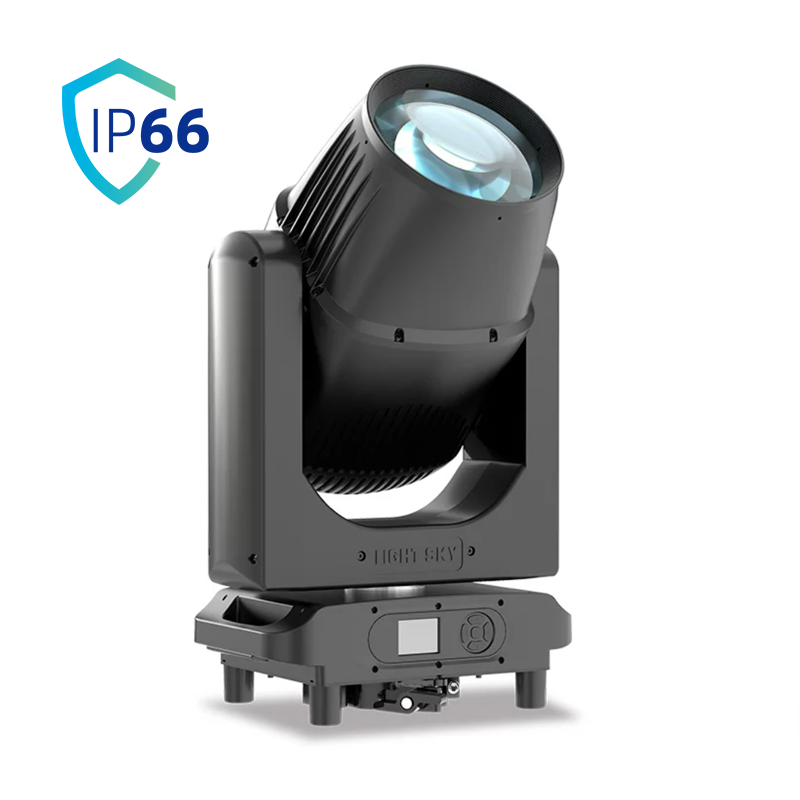
Start with the Venue Environment
Outdoor lighting should be planned around the actual installation location. A garden, terrace, courtyard, or partially covered reception area can expose equipment to different levels of moisture, dust, temperature changes, and wind.
An IP rating should be treated as a defined technical specification rather than a general promise of unlimited outdoor use. IP66 provides protection against dust and water according to its rating, while the complete installation still requires suitable power connections, cable management, mounting, and operating procedures.
When considering a waterproof moving head light, we should therefore evaluate both the fixture and its surrounding setup. The weather protection of the housing does not automatically mean that every cable, connector, or power component is suitable for the same conditions.
Temperature also needs to be checked before deployment. The expected operating conditions should remain within the manufacturer’s specified range, with site procedures followed if weather conditions change.
Match Beam Output with the Lighting Plan
Beam fixtures are different from broad wash fixtures because they produce concentrated directional effects. A narrow beam can be used to define areas, emphasize architectural elements, or create movement during selected parts of a reception.
We should first determine the purpose of each beam before deciding its position. A fixture aimed toward an entrance may serve a different function from one positioned near a dance floor or stage backdrop.
The 1.3° beam angle specified for MINI WHALE is particularly relevant when planning narrow directional effects. However, the final appearance still depends on fixture distance, mounting position, surrounding structures, atmospheric conditions, and programming.
A professional lighting company should therefore consider beam placement as part of the complete venue design rather than as an isolated equipment decision.
Use Effects with a Clear Purpose
Color, gobos, prisms, focus, strobe, and dimming can change how a beam fixture contributes to a wedding reception. Effective programming starts by deciding what each function is intended to achieve.
For example, color changes can separate different parts of a reception, while gobos can introduce projected patterns. Prism effects can modify the appearance of the beam, while focus and dimming can help control the visual output.
The MINI WHALE specification lists a 14-color wheel plus blank, 17 fixed gobos plus blank, independently rotating 8-facet and 24-facet prisms, motorized focus, adjustable pulse strobe, and linear dimming. These functions provide several options for programmed scenes.
For a waterproof moving head light, effect selection should also take the outdoor environment into account. Darkness, venue structures, reflective surfaces, and atmospheric conditions may influence how clearly beams and projected effects are seen.
Coordinate Movement with the Reception Schedule
Wedding receptions normally include several different activities, such as entrances, speeches, dining, performances, and dancing. Lighting movement should correspond with these changes rather than operating at the same intensity throughout the event.
During speeches, controlled lighting can keep attention on the speaker. During entertainment periods, moving beams can become more active. This makes the lighting program easier to relate to the event schedule.
Pan and tilt movement should also be checked against the physical layout. Tables, decorations, performers, and guest areas can affect the usable movement range once the venue is fully arranged.
A professional lighting company can organize lighting cues according to the reception timeline and test movement paths before guests arrive.
Check Control and Power Requirements
Control compatibility should be confirmed before installation. MINI WHALE supports DMX512 and RDM, with ArtNet listed as an optional control method. Its control configuration is specified as 15 channels.
These details help production teams determine how the fixture will fit into the existing lighting-control system. Addressing, programming, testing, and operation can then be planned before the event.
Power requirements also need to be considered. The fixture is specified for AC 100–240V, 50/60Hz, with a maximum power rating of 460W. These figures should be used when planning power distribution and checking the venue’s available electrical arrangements.
The listed dimensions of 344 × 238 × 601 mm and net weight of 22.1 kg should also be considered for transportation, mounting, positioning, and installation access.
Plan Mounting and Cable Routing
A weather-ready lighting setup requires attention to physical installation as well as fixture protection. Mounting locations should provide suitable support and allow technicians to inspect or adjust equipment when necessary.
Cable routing should also be planned before the event. Cables need to be positioned appropriately for the venue while avoiding unnecessary exposure to physical damage or creating hazards around guest areas.
We should not select a mounting position based only on the desired beam direction. Structural support, power access, control connections, guest circulation, and venue requirements all need to be considered together.
Keep Weather Protection Within Its Specification
Weather-ready equipment should not be treated as equipment that can operate under every possible weather condition. The correct approach is to compare the manufacturer’s specifications with the conditions expected at the venue.
For MINI WHALE, IP66 protection and the specified -10°C to 40°C operating environment provide two separate technical references. They should be considered alongside installation practices and the venue’s safety requirements.
A waterproof moving head light should therefore be selected according to documented specifications instead of broad descriptions such as “all-weather.” This gives planners and production teams a clearer basis for technical decisions.
Build the Final Plan Around Practical Requirements
Weather-ready beam accents work best when fixture specifications are connected with the actual reception environment. LiGHT SKY MINI WHALE combines IP66 protection, a 1.3° beam angle, moving-head operation, multiple optical effects, and established control options for wedding and dynamic-event applications.
As a professional lighting company, LiGHT SKY provides MINI WHALE for production teams that need to evaluate directional beam lighting according to specific venue conditions. We recommend checking environmental exposure, beam requirements, control, power, mounting, cable routing, and operating temperature before deployment. This keeps the lighting plan based on documented specifications and practical event requirements.