What to Consider When Using MINI LASER AQUA for Compact Laser Effects in Clubs
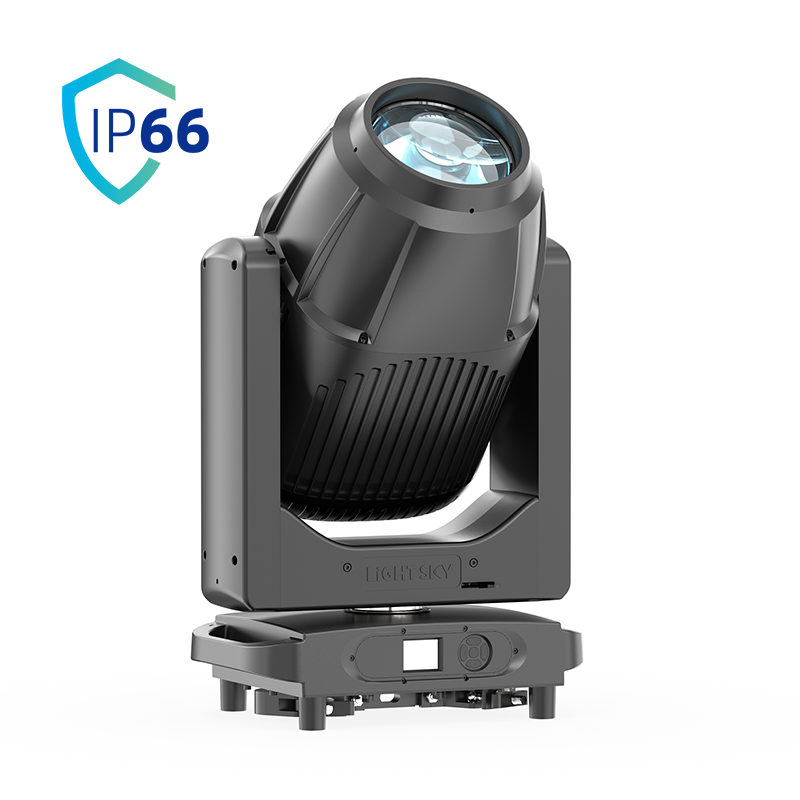
For club operators and lighting designers, compact laser fixtures can provide another way to shape the visual structure of a venue without relying only on conventional wash or beam fixtures. At LiGHT SKY, we position MINI LASER AQUA as a compact laser moving light designed for outdoor stage and entertainment applications. Its 100W laser source, narrow 1.1° beam, color system, gobo functions, prism effects, and IP66 protection give us a practical starting point for discussing how laser effects can be planned for club environments.
Start With the Role of Laser Effects in a Club
A laser fixture should first be considered according to the visual function it needs to perform. A narrow beam can create a defined line through haze, while movement can help distribute that effect across different parts of a venue. This makes beam direction, fixture position, and programming important parts of the planning process.
For a club installation, we should also consider how laser effects interact with existing lighting. If moving heads, strobes, washes, and screens already occupy much of the visual field, additional effects need to be programmed with a clear purpose rather than simply increasing the number of active fixtures.
Color is another planning variable. A white laser light source can provide a neutral starting point, while a color wheel and CMY system allow the output to be integrated with a broader lighting palette. The useful approach is to coordinate color changes with the musical or visual structure of the event.
Think About Beam Angle and Projection Distance
Beam geometry directly affects how a fixture appears in a room. A narrow optical angle concentrates light into a tighter path, which can make beam movement easier to distinguish when atmospheric conditions allow the beam to become visible.
The MINI LASER AQUA uses a 1.1° beam angle and a 128mm optical lens. These specifications indicate that it is designed around narrow, long-throw projection rather than broad area coverage. For club designers, this means fixture placement should be considered alongside the height, depth, and sightlines of the venue.
Haze also matters because a beam is not equally visible under every atmospheric condition. The visible effect depends on airborne particles, viewing angle, ambient light, and the surrounding surfaces. Therefore, lighting programmers should evaluate the actual room rather than assuming that a narrow beam will always produce the same visual result.
Match Movement With the Venue Layout
Moving effects become more useful when their movement is coordinated with the physical structure of the club. Pan and tilt ranges determine how much of the available space can be addressed from a particular mounting position.
The fixture provides 540° pan movement and 270° tilt movement, with 8-bit and 16-bit precision options. For designers, these specifications can support different programming approaches, from controlled directional movements to broader changes between sections of a show.
Positioning should still be based on practical sightlines. Fixtures mounted too close to obstructions may lose part of their usable movement range, while poorly coordinated movement can interfere with other lighting effects. We should therefore map the fixture’s physical range before building complex cues.
Use Gobo and Prism Effects as Secondary Layers
Laser effects do not have to depend entirely on beam movement. Gobo projection can introduce recognizable shapes, while prisms can divide and layer the beam to create a more complex visual structure.
The MINI LASER AQUA includes 17 fixed gobo patterns plus a blank position, together with 8-facet and 24-facet prism options. These functions provide several ways to modify the beam without changing the fixture position.
For club programming, this creates an opportunity to separate different show sections through effect selection. A simpler beam can support transitions, while gobo or prism combinations can be reserved for moments that require more visual detail.
Consider Weather Protection for Outdoor Club Events
Although many clubs are indoor venues, outdoor parties, temporary stages, poolside events, and open-air entertainment can introduce different equipment requirements. Weather protection becomes particularly relevant when lighting fixtures are exposed to moisture or changing environmental conditions.
The fixture carries an IP66 protection rating and is specified for an operating environment from -20°C to 45°C. These specifications provide useful reference points when planners evaluate whether the fixture’s stated environmental capabilities match the conditions of a particular event.
An outdoor sky laser light should still be planned around the actual installation environment. Protection ratings do not remove the need for correct mounting, cabling, power distribution, and operational procedures.
Plan Control and System Integration Carefully
Laser effects are most useful when they can operate as part of the wider lighting system. Control compatibility affects how easily programmers can integrate a fixture into an existing workflow.
The fixture supports DMX512, RDM, and Art-Net, with 17-channel and 19-channel control modes. This provides several control options for different production environments. The choice of control method should depend on the venue’s console, network architecture, operator workflow, and the complexity of the programmed show.
Noise can also become a consideration in clubs where the lighting system is installed near audiences or other sensitive areas. The fixture provides high-brightness, standard, and silent modes, allowing operators to consider brightness and operating noise as part of the overall setup.
Build the Effect Around the Whole Lighting System
Compact laser fixtures work best when their output has a defined relationship with the rest of the lighting design. Rather than treating the laser as an isolated attraction, we can use beam direction, color, gobo selection, prism effects, and movement as separate programming layers.
At LiGHT SKY, MINI LASER AQUA brings these functions together in a compact moving-light format. Its white laser source, narrow beam optics, effect functions, movement system, control protocols, and IP66 construction give lighting professionals several parameters to evaluate when planning club and outdoor entertainment applications. By matching those specifications with venue geometry, control requirements, atmospheric conditions, and the intended visual structure, we can use compact laser effects in a more controlled and practical way.