What A Waterproof Moving Head Light Can Add To Waterfront Brand Events
Waterfront brand events have a visual advantage that conventional venues cannot easily reproduce: reflections, open sightlines, changing skies, and architectural surroundings can all become part of the experience. The challenge is keeping the lighting expressive without allowing the environment to dictate every technical decision. A waterproof moving head light can provide concentrated beams and moving visual accents while fitting into an event concept built around water, evening views, and brand identity. At LiGHT SKY, we view outdoor lighting as a combination of optical design, environmental considerations, audience comfort, and creative timing rather than simply adding brighter fixtures.
Turn The Waterfront Into Part Of The Scene
A waterfront location offers more than an attractive background. Glass façades, railings, boats, trees, bridges, and nearby structures can reflect or partially absorb light, creating secondary visual layers. Rather than illuminating every surface, designers can select a few architectural or environmental elements that support the brand’s visual language. A controlled beam aimed toward an appropriate background, for example, can establish depth without overwhelming the main presentation area.
The event schedule also changes how these elements should be treated. Natural light may dominate during a product presentation in the afternoon, while the same location can look dramatically different after sunset. A lighting plan that gradually introduces stronger color and movement allows the atmosphere to evolve instead of switching abruptly from daylight to a fully programmed show.
The surrounding environment becomes more useful when lighting choices are based on what the venue already offers.
Balance Brand Visibility With Visual Effects
Corporate events often combine product demonstrations, speeches, networking, music, and entertainment. Each section has different visual priorities. A presentation requires clear faces and readable branding, whereas a DJ set may benefit from faster movement and stronger contrast. Using one lighting look throughout the event can flatten those differences and make important moments less distinctive.
Color deserves particular attention because brand colors may behave differently under high-intensity stage sources. Designers should consider how the selected hue appears on people, signage, merchandise, LED screens, and reflective surfaces. A restrained color palette can sometimes communicate a brand identity more effectively than constantly changing colors.
We find visual effects become more convincing when they support the communication goal instead of competing with it.
Use Beam Geometry To Control Attention
Beam angle is one of the most practical specifications to examine when comparing DJ moving head lights. A narrow optical system can produce concentrated aerial effects, while wider coverage serves a different purpose. The correct choice depends on throw distance, fixture position, atmospheric conditions, stage dimensions, and the intended viewing angle.
For a waterfront event, designers should also think about where the beam terminates. A strong projection toward open water may create an attractive reflection, but the same effect can become distracting if it crosses the audience’s eye line. Rehearsal from guest positions is therefore valuable, particularly when the event combines moving fixtures with photography, video screens, and architectural lighting.
Optical precision gives operators more control over where visual attention lands.
A Compact Fixture With A Defined Optical Role
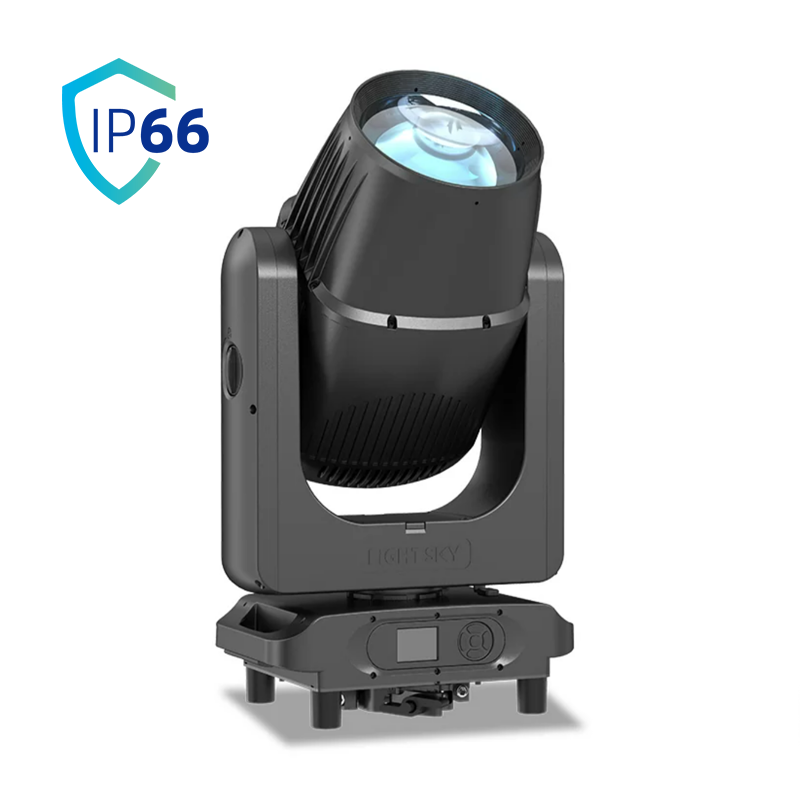
At LiGHT SKY, we developed the MINI WHALE, a compact pure‑beam waterproof moving‑head built for dynamic use‑cases including weddings, nightclubs, car shows and comparable live events. Its official datasheet specifies a φ170 mm optical lens, 8000 K colour temperature, CRI Ra≥80, and 720 000 lux at 10 m. Equipped with an OSRAM NED40 light‑source, it delivers a 1.3° beam output. Its 8‑facet and 24‑facet prisms work either independently or combined to generate diverse beam patterns, and the fixture holds an IP66 environmental rating.
These specifications demonstrate that lighting hardware ought to be selected based on functional performance rather than outward appearance. The tight 1.3° beam excels for focused projection and aerial beam effects, and the dual‑prism system adds extra visual texture. For waterfront‑venue productions, these capabilities serve entertainment‑focused segments well, while separate fixtures take responsibility for broad‑area stage illumination and ensuring good visibility for presenters.
A clearly defined fixture role helps prevent a lighting system from becoming unnecessarily complicated.
Coordinate Lighting With Cameras And Screens
Waterfront events frequently involve livestreaming, photography, or large-format LED displays. These media layers can change the perceived brightness of the scene. A beam that appears balanced to guests may create excessive contrast on camera, while a bright screen can make nearby performers appear comparatively dark.
We therefore believe camera positions should be checked before we lock the final cue structure. We recommend operators reserve calmer lighting states for speeches and product demonstrations, then introduce more movement once the program shifts toward entertainment. We also need to observe reflections from water and glass through the camera, as they may produce highlights that are less obvious from the audience area.
A lighting system becomes more versatile when its effects are designed with both human and camera viewpoints in mind.
Conclusion
A waterfront brand event does not need constant movement to feel visually dynamic. The strongest results usually come from contrast: quiet looks can frame presentations, directional beams can add energy to entertainment, and carefully timed color changes can reinforce transitions. Environmental protection, beam geometry, camera positions, and guest sightlines all deserve attention before the creative cues are finalized.
At LiGHT SKY, we approach event lighting by connecting fixture specifications with the actual conditions of each project. Teams comparing DJ moving head lights can start with beam angle, throw distance, movement, optical effects, and environmental requirements rather than focusing on appearance alone. Used with a clear purpose, a waterproof moving head light can add depth and movement to a waterfront setting while leaving the brand, audience, and event itself at the center.