Using SUPER SCOPE PLUS to Add Long-stage Visual Control to Indoor Arenas
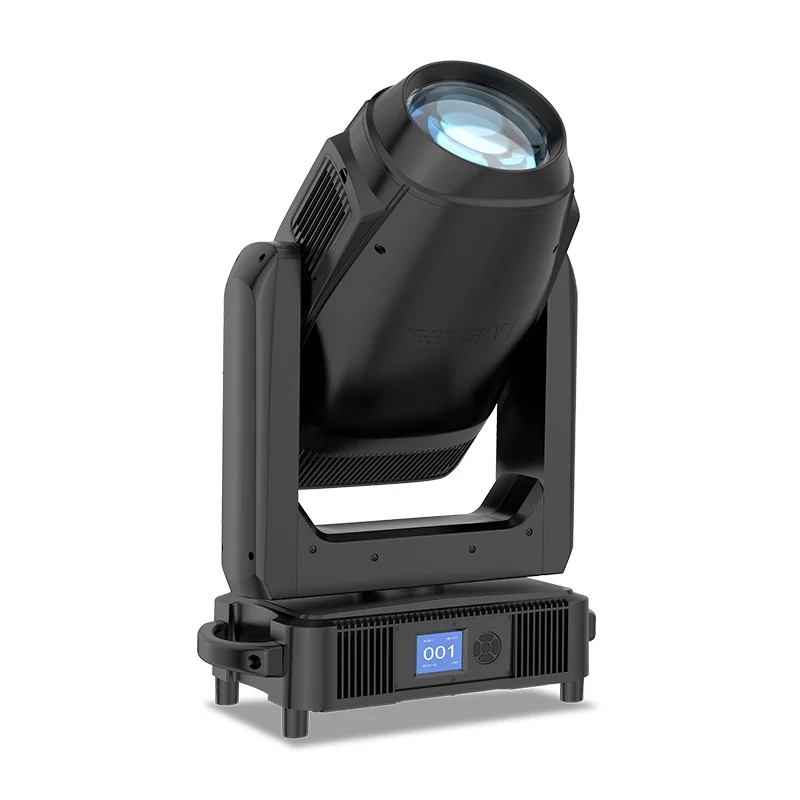
Indoor arenas place different demands on lighting than smaller performance spaces. The distance between fixtures and the performance area can be substantial, while audiences may be distributed across wide seating sections. We use LiGHT SKY SUPER SCOPE PLUS as an example of how an LED BSWP 4in1 moving head spotlight can combine projection, color control, framing, and movement when long-stage visual control is required. Its beam, spot, wash, and profile functions provide several lighting approaches within one fixture.
Why Long-throw Control Requires More Than Brightness
Lighting a large indoor arena is not simply a matter of increasing output. A fixture must also direct light accurately so that the intended area receives sufficient illumination without unnecessarily spreading light into surrounding spaces.
For this reason, optical design matters alongside output. A narrow beam can help project light toward distant areas, while a wider zoom range provides more flexibility when the fixture is used for different stage positions or coverage requirements.
SUPER SCOPE PLUS uses an 180 mm optical lens and provides a 5.5°–52° zoom range. The listed total lumen output is 41,000 lm, giving production teams defined optical characteristics to consider when planning longer-distance applications.
For arena production teams, the practical question is therefore how the fixture’s optical range matches the distance, mounting position, and required visual area rather than relying on brightness as the only selection criterion.
Shaping Light for Different Areas of the Arena
Large stages rarely require the same beam shape throughout a complete production. A presentation may need a defined projection area, while another section may call for broader coverage or a softer appearance.
A useful fixture therefore needs mechanisms that allow operators to modify the shape and distribution of light. Stage wash lighting is generally associated with broader illumination, while profile functions are more useful when precise edges or controlled framing are needed.
The four-blade framing system of SUPER SCOPE PLUS allows each blade to move in eight directions, with the system providing ±55° rotation. This gives operators a way to shape the projected beam rather than treating every output as an unrestricted cone of light.
This type of control can be particularly relevant when the lighting position is fixed but the visual target changes during a show. Instead of changing the physical location of the fixture, operators can adjust framing to modify the illuminated area.
Using Color and Gobo Functions as Control Tools
Color selection also affects how visual information is organized across a large venue. Different areas can be separated through color, while gradual changes can support transitions between production cues.
SUPER SCOPE PLUS includes a five-color wheel with open and high-CRI filter positions, together with infinite CMY color mixing and linear CTO adjustment from 2800K to 6800K. These functions give programmers several methods for managing color relationships across different scenes.
Gobo functions provide another layer of visual structure. The fixture has two rotating gobo wheels, with each wheel holding seven interchangeable gobos. Rotation, shaking, and transitions allow projected patterns to become part of the lighting design rather than remaining limited to static color changes.
For an indoor arena, this can help production teams distinguish between general illumination, scenic projection, and effect-based cues while keeping these functions within the same moving-head platform.
Coordinating Movement with Arena Programming
Long-stage visual control also depends on how fixtures move between positions. A light mounted above or behind a large stage may need to redirect its output across different performance zones without requiring manual repositioning.
SUPER SCOPE PLUS provides 540° pan and 270° tilt movement, with automatic error correction during reset. Its control system supports DMX512, RDM, Art-Net, and sACN, while 43-channel and 55-channel modes provide different levels of control.
For programmers, these options make fixture integration an important part of system planning. The selected control protocol, channel mode, movement positions, and cue structure should correspond with the venue’s existing lighting network and operating workflow.
The fixture also provides electronic dimming from 0–100% and an adjustable strobe function. These controls allow intensity and timing to be incorporated into programmed transitions without changing the fixture’s physical position.
Managing Operational Requirements in Indoor Venues
Arena lighting systems must also account for operating conditions, maintenance, and noise considerations. These factors can influence where a fixture is installed and which operating mode is appropriate for a particular production.
SUPER SCOPE PLUS includes high-brightness, standard, and silent operating modes, along with intelligent temperature control. The listed operating environment is 0°C to 40°C, and the fixture carries an IP20 rating.
These specifications should be considered during venue planning rather than treated as secondary details. Indoor installation does not automatically remove the need to assess temperature, ventilation, fixture placement, and operating conditions.
Applying the Fixture to Long-stage Arena Design
A practical arena lighting plan starts with the intended visual task. Teams can first identify distant performance zones, scenic surfaces, audience-facing areas, and positions where controlled projection is required. The next step is matching beam angle, framing, color, and movement functions to those zones.
This approach also helps avoid using every available effect simply because it exists. A narrow projection may be appropriate for one cue, while a wider wash may be more useful for another. Gobo projection, framing, frost, prism, and iris functions can then be introduced according to the visual requirement.
SUPER SCOPE PLUS combines beam, spot, wash, and profile functions in one fixture, alongside framing, gobo, prism, frost, iris, zoom, and movement controls. For arena productions, LiGHT SKY positions the fixture for theaters, TV studios, concerts, stadiums, touring productions, and other large venues.
Bringing Long-stage Visual Control Together
When we plan lighting for an indoor arena, our focus is on matching optical performance, beam shaping, color control, movement, and programming requirements to the actual venue. LiGHT SKY SUPER SCOPE PLUS brings these functions together through its LED BSWP 4in1 moving head spotlight design, 180 mm lens, framing system, gobo functions, movement range, and multiple control protocols.
Rather than treating long-stage lighting as a single brightness requirement, we can use these functions as separate control tools within one fixture. That makes the planning process more structured: determine the visual target, select the required beam and framing characteristics, coordinate movement and control, and then build the appropriate cues. For indoor arenas where distance and coverage must be considered together, this provides a practical basis for developing controlled stage visuals.