AQUAPEARL-MINI for Exhibitions: Three Basics Around Color-Focused Displays
Exhibition lighting has to do more than simply make a booth or display visible. We need to consider how color, beam coverage, movement, and control work together when products, brand graphics, or architectural elements are presented to visitors. For this reason, understanding the basic functions of moving wash fixtures can help production teams make more practical lighting decisions.
Start With Color Mixing and Individual Control
Color-focused exhibition lighting begins with how accurately and flexibly a fixture can produce different visual tones. RGBW systems combine red, green, blue, and white LED sources, allowing lighting teams to create a wider range of colors while retaining access to white output.
An LED moving wash can therefore be useful when an exhibition design requires changing color across different display areas. Rather than treating color as a fixed decorative layer, we can use it to separate zones, emphasize structures, or adjust the visual atmosphere during different parts of an event.
Individual LED control adds another layer of flexibility. When each LED source can be controlled separately, the fixture can produce more dynamic color effects instead of operating only as one uniform light source. This distinction matters when the lighting design includes movement or programmed visual changes.
For exhibition production, color control should also be considered alongside the content being displayed. Strong color contrast may help separate an illuminated structure from its surroundings, while more restrained combinations can keep attention on products or graphics.
Match Beam Coverage With Display Distance
Color alone does not determine whether a fixture is suitable for an exhibition space. Beam spread and zoom range influence how the light reaches the intended surface. A narrow beam can concentrate output, while a wider wash can cover a larger area.
The AQUAPEARL-MINI provides a linear electric zoom system with a 5°–50° zoom range, while its listed beam angle range is 4°–32°. This gives production teams different optical approaches within one fixture rather than requiring every position to serve exactly the same purpose.
When selecting LED moving head professional show lighting, we should first identify the physical distance between the fixture and the display surface. A narrow setting may suit a concentrated visual element, whereas a wider setting can be considered for broader walls, structures, or exhibition areas.
The same principle applies to moving fixtures. Pan and tilt ranges determine where the light can be directed, so fixture placement should be planned together with the required coverage rather than after the installation is complete.
Consider Control, Movement, and Practical Installation
A professional exhibition system also needs a workable control structure. The AQUAPEARL-MINI supports DMX512, RDM, and Art-Net, with several selectable control-channel configurations. These options allow lighting teams to integrate the fixture into different control environments according to the production setup.
Movement can also contribute to color-focused displays when it is used deliberately. The fixture provides 540° pan and 250° tilt movement, with 8-bit and 16-bit precision options. This makes movement another controllable parameter rather than an effect that needs to remain active throughout a presentation.
For temporary exhibition installations, physical handling is equally relevant. The fixture has a listed net weight of 12.3 kg, while its IP66 rating supports both indoor and outdoor stage applications according to the product information. These characteristics can be considered when planning transportation, mounting, and venue conditions.
A practical workflow should therefore connect programming with installation. We can first define the display surfaces, then determine beam coverage, color requirements, movement positions, and finally the control method. This sequence reduces unnecessary adjustments during setup.
Turning the Three Basics Into a Practical Plan
Color, optical coverage, and control should not be treated as separate technical specifications. They interact throughout an exhibition lighting design. A fixture may provide extensive color options, but the result still depends on where it is positioned, how widely the beam is opened, and how the lighting cues are programmed.
For teams working across different exhibition layouts, flexibility can be more useful than relying on one fixed lighting look. A compact moving fixture with adjustable zoom, individual LED control, pan and tilt movement, and multiple control protocols can support several types of visual arrangements without changing the basic equipment concept.
We also need to keep the surrounding environment in consideration. Exhibition spaces can contain reflective surfaces, printed graphics, transparent materials, and other illuminated elements. Testing the actual color and beam interaction before the event can help avoid excessive brightness or unwanted visual overlap.
Applying the Approach With AQUAPEARL-MINI
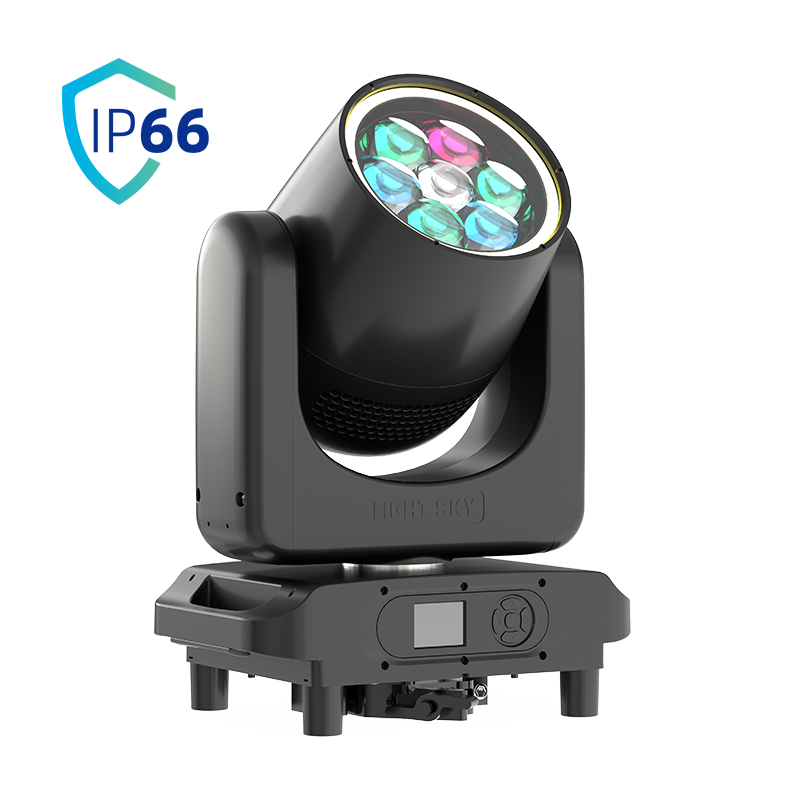
At LiGHT SKY, we position the AQUAPEARL-MINI as a compact IP66 mini LED wash moving head designed for indoor and outdoor stage applications, including exhibitions. Its 7 × 60W RGBW 4-in-1 LED configuration, individual LED control, 360° rotating front lens, and flexible zoom system provide several tools for building color-oriented displays.
For exhibition teams, the practical value lies in combining these functions according to the space rather than using every effect at once. By starting with color requirements, matching the optical coverage to the display, and then organizing movement and control, we can build a more structured approach to exhibition lighting with AQUAPEARL-MINI.