IP-Rated Moving Head Fixtures: Cooling, Condensation and Long-Term Reliability
Professional lighting fixtures used in demanding environments face more than rain or dust. Heat buildup, condensation, and continuous operation can all influence long-term performance if a fixture is not properly engineered. For rental companies, production contractors, and system integrators, selecting a waterproof moving head light involves evaluating much more than an IP rating. The overall design of the optical system, cooling structure, and internal components plays an equally important role in ensuring reliable operation throughout the equipment’s service life.
As entertainment projects become increasingly diverse, buyers are placing greater emphasis on fixtures that combine environmental protection with stable performance. Understanding how manufacturers address cooling and condensation can help purchasing teams make more informed sourcing decisions.
Why IP Ratings Are Only Part of the Reliability Story
An IP rating indicates how well a fixture resists the ingress of dust and water, but it does not describe the overall quality of the product. Two fixtures with the same protection rating may perform very differently depending on their mechanical design, thermal management, and manufacturing quality.
Professional lighting generates significant heat during operation. If internal temperatures are not managed effectively, optical components, electronic circuits, and moving mechanisms may experience reduced efficiency over time. Likewise, rapid temperature changes between daytime and nighttime conditions can create condensation inside poorly designed fixtures, potentially affecting performance.
For this reason, experienced buyers evaluate the complete engineering approach rather than relying solely on published IP classifications. Reliable design, precision manufacturing, and comprehensive product testing all contribute to long-term operational stability.
Engineering for Long-Term Performance
Developing a dependable waterproof moving head light requires careful coordination between optical performance, cooling efficiency, and environmental protection. Engineers must ensure that airflow, sealing, and heat dissipation work together without compromising movement accuracy or lighting output.
Professional manufacturers also conduct extensive testing before products enter the market. Mechanical movement, optical alignment, electronic stability, and continuous operating performance are evaluated to verify that fixtures can maintain consistent output throughout demanding production schedules.
We at LiGHT SKY develop professional lighting products for concerts, theatres, television studios, touring productions, festivals, and architectural applications. We continue investing in engineering innovation and incorporates DTCS™ on supported models to help optimize operating temperatures during extended operation.
How MINI WHALE Delivers Versatility in Professional Applications
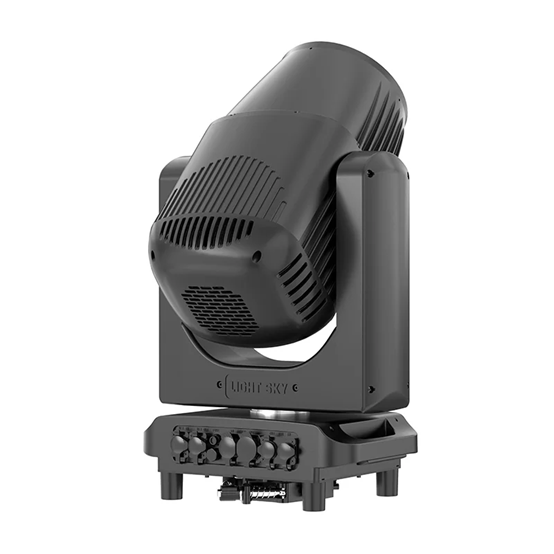
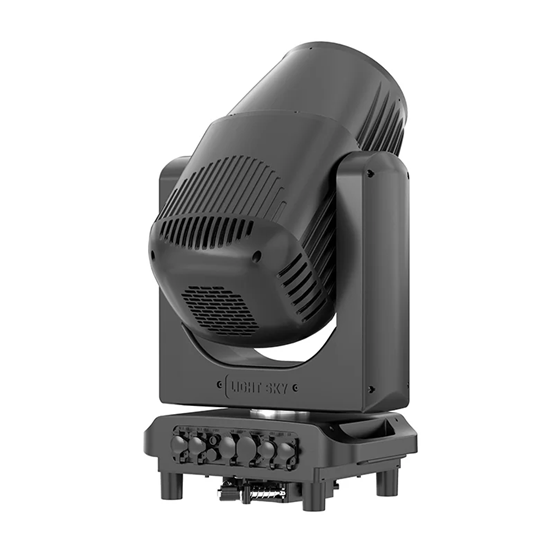
Compact fixtures are increasingly popular. As the primary product featured in this article, MINI WHALE demonstrates how a compact fixture can support multiple lighting requirements while simplifying transportation and installation.
MINI WHALE delivers professional beam performance in a compact waterproof design, making it suitable for applications where transportation efficiency and reliable operation are important. Equipped with an OSRAM NED40 light source and a precision optical system, the fixture produces sharp aerial beams for concerts, touring productions, festivals, and other entertainment applications.
The fixture also features rotating gobos, fixed gobos, an 8-facet prism, a 24-facet prism, motorized focus, strobe effects, and linear dimming functions. These features allow lighting programmers to create dynamic beam effects while maintaining flexibility across different production environments.
How LiGHT SKY AQUAPEARL-MINI Complements Moving Head Stage Lights
Professional productions often combine different moving head stage lights to achieve layered lighting effects. Among the compact wash fixtures from LiGHT SKY, AQUAPEARL-MINI stands out for its balance of output, zoom flexibility, and creative lighting effects, making it a practical choice for concerts, touring productions, and entertainment venues. While compact beam and wash fixtures provide flexibility, specialized wash fixtures help create smooth colour transitions and even stage illumination.
A representative example is LiGHT SKY AQUAPEARL-MINI. It is equipped with seven 60 W RGBW LEDs and offers a motorized zoom range from 4° to 50°. It also features individual pixel control, smooth electronic dimming, variable strobe effects, and precise colour mixing, allowing lighting designers to create both powerful beam looks and wide wash effects from the same fixture.
Its compact size makes it suitable for touring productions, performance venues, television studios, and entertainment installations where installation space may be limited but creative flexibility remains important. When used together with MINI WHALE, lighting designers can build versatile lighting systems capable of supporting a wide range of visual styles while simplifying equipment management.
Looking Beyond Specifications When Selecting Fixtures
Technical specifications provide valuable information, but these specifications represent only one part of the purchasing decision. Buyers should also evaluate manufacturing capability, engineering expertise, quality control procedures, and after-sales support when comparing suppliers.
Long-term reliability is achieved through consistent product design, precision manufacturing, and continuous product improvement rather than a single specification on a product page. Manufacturers that invest in these areas are generally better prepared to support professional customers throughout the equipment lifecycle.
For distributors, rental companies, and production professionals, selecting dependable lighting equipment requires a balance of performance, durability, and operational efficiency. At LiGHT SKY, we focus on developing lighting solutions that balance performance, durability, and practical application needs. This approach helps distributors, rental companies, and production professionals select equipment that delivers reliable value throughout the product lifecycle.