
How MINI WHALE Can Support A Flexible Look For Charity Run Finish-Line Stages
Charity run finish-line stages need to serve several purposes within a short period: welcoming participants, supporting announcements, creating photo opportunities, and shifting into celebration mode as the event develops. A waterproof moving head light can contribute to these transitions through controlled beams, movement, and programmed effects without requiring an overly complicated visual system. At LiGHT SKY, we view lighting around the finish line as part of the event environment, where visibility, audience comfort, camera positions, and the pace of the program all deserve consideration.
Create A Clear Visual Focus
Finish-line areas can become visually crowded once runners, volunteers, sponsors, photographers, and spectators gather around the same space. Lighting can help establish a clear visual hierarchy by separating the stage, finish arch, announcement area, and nearby audience zones.
Rather than illuminating every surface equally, designers can concentrate stronger effects around moments that deserve attention. Sponsor acknowledgments may use a stable look, while award presentations can receive a more defined stage treatment. Such differentiation helps the audience understand where the important action is taking place.
The best lighting plan usually gives each part of the finish-line environment a recognizable role.
Plan Changes Around The Event Timeline
Charity runs rarely maintain one atmosphere from start to finish. Early announcements may require calm illumination, the arrival of runners can bring greater excitement, and the award ceremony may call for a more polished presentation look. Later entertainment can introduce stronger movement and effects.
Cue programming makes these changes easier to manage. Operators can prepare separate scenes for speeches, participant arrivals, sponsor moments, awards, and music. Keeping those cues logically organized also helps the production team respond if the running schedule changes.
Visual variety becomes more meaningful when it follows the actual rhythm of the event rather than appearing continuously.
Use Beam Effects With Restraint
The visual role of a moving beam light is different from broad stage coverage. Its concentrated projection can create visible shafts through atmospheric conditions or draw attention toward selected architectural or scenic surfaces. Such effects work particularly well when the finish-line area needs greater energy after the main race activity has slowed.
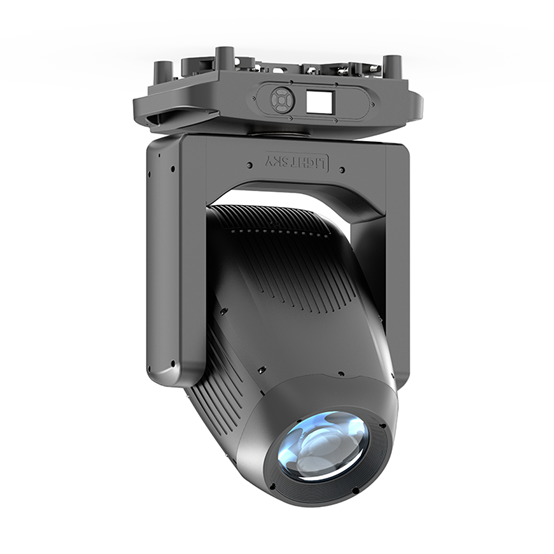
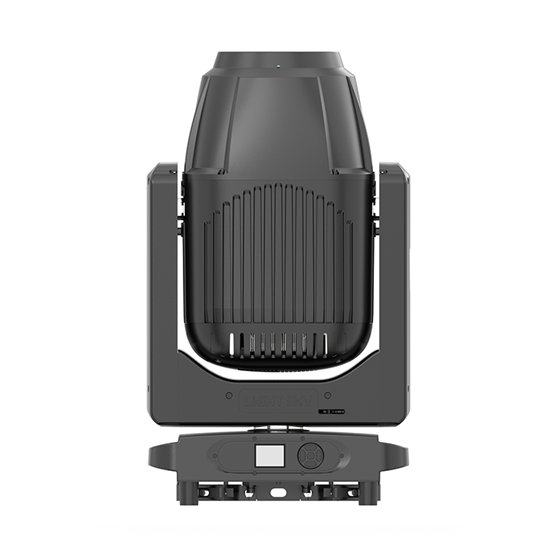
The MINI WHALE from LiGHT SKY delivers versatile functions to support this type of programming. At LiGHT SKY, we equip it with a 15-channel control system that supports DMX512 and RDM, with Art-Net offered as an optional feature. The fixture also features 3-pin and 5-pin XLR DMX/RDM input and output ports, an LCD display, and DMX512-based software upgrades. These comprehensive control options give operators great practical flexibility when integrating the fixture into existing event console systems.
Using only the functions required by each cue keeps operation manageable while leaving room for more expressive scenes later in the program.
Consider The Audience And Camera Positions
Finish-line stages attract people from many directions. Spectators may stand behind barriers, runners approach from different angles, and photographers often move between the stage and the course. Beam placement therefore needs to be evaluated from several viewing positions rather than only from the lighting desk.
Camera exposure is another important consideration. A strong beam directly behind a speaker can produce excessive contrast, while rapid changes may affect photographs taken during award presentations. A calmer scene can be reserved for speeches and group photos, with more active effects introduced during entertainment.
Visual impact works better when the lighting remains compatible with the way people actually experience and document the event.
Keep Outdoor Operation Practical
We regard weather conditions as a vital factor in planning outdoor charity run productions. Rain, humidity, dust, temperature fluctuations, and exposed circuit connections all influence our equipment layout and overall planning. Therefore, when we select outdoor lighting fixtures, we comprehensively evaluate their protection ratings, mounting methods, cable arrangements, and power distribution systems to ensure stable and reliable on-site operation.
The control workflow should receive similar attention. Operators can test addressing, signal paths, cue transitions, and fixture responses before the audience arrives. Backup scenes are also useful if the event schedule changes because of race timing or weather.
Technical preparation gives the creative side of the production more room to adapt during a live event. Having spare fixtures and extension cables on hand also helps if repositioning becomes necessary on the day.
Conclusion
Finish-line lighting does not need to turn every moment into a large-scale spectacle. Clear visual priorities, carefully timed cues, suitable beam placement, and sensible control programming can create noticeable changes while preserving the practical needs of a community sporting event.
We take this approach at LiGHT SKY, where fixture capabilities are considered alongside venue conditions and production objectives. Properly programmed moving beam light effects can add energy to selected moments without overwhelming the stage, while a waterproof moving head light can be considered when the outdoor environment calls for suitable weather protection. A flexible finish-line design ultimately comes from matching each technical choice to a specific moment in the event.