
How An LED Wash Moving Head Can Shape Different Parts Of Large Awards Nights
Large awards nights depend on visual transitions as much as speeches, performances, and presentations. LED wash moving head fixtures can help divide a large stage into distinct visual zones, giving the lighting plot greater flexibility without requiring every area to look identical. The challenge lies in balancing brightness, color, movement, and camera-friendly presentation. At LiGHT SKY, we approach stage lighting as a combination of atmosphere, spatial definition, and carefully timed visual changes rather than simply adding more fixtures.
Creating A Clear Visual Hierarchy
Large award ceremonies usually contain several important areas: the main presentation position, performance space, backdrop, entrance route, and audience-facing branding. Treating these areas with exactly the same intensity can make the stage appear flat. Instead, lighting can establish different levels of attention through beam direction, color temperature, and coverage.
The central presentation area generally benefits from controlled illumination because presenters and recipients need clear visibility. Surrounding areas can use softer washes or restrained color to create depth without competing with the people on stage. When adjusting the central brightness, designers should also consider how the surrounding wash responds—a slight dimming of the periphery during key moments can naturally draw focus without making the stage feel empty.
Another useful technique is to think in layers. Front light supports facial visibility, side light adds dimensionality, and background illumination separates people from scenery. This layered approach allows one stage to appear different from one segment to another without major physical changes.
Matching Light To Ceremony Segments
Award ceremonies rarely maintain one visual mood throughout the evening. Guest arrival, opening remarks, nominee introductions, winner announcements, performances, and closing moments each carry different emotional weight. Recognizing these emotional shifts during the planning stage allows the lighting designer to anticipate changes rather than react to them during the live broadcast.
A restrained palette can suit formal presentations, while more saturated colors may work during entertainment sections. Transitions should follow the rhythm of the program rather than occur simply because the fixture has movement capabilities. A well-paced transition that responds to the music or the speaker’s tone tends to feel more intentional and less distracting than a change timed purely to fill a gap in the cue list.
Timing also matters. A gradual change during an introduction feels very different from a rapid shift accompanying music or a reveal. Programming should therefore consider the audio cue, speaker position, camera framing, and expected audience attention before selecting movement speed or color transitions.
Understanding Modern Wash Fixtures
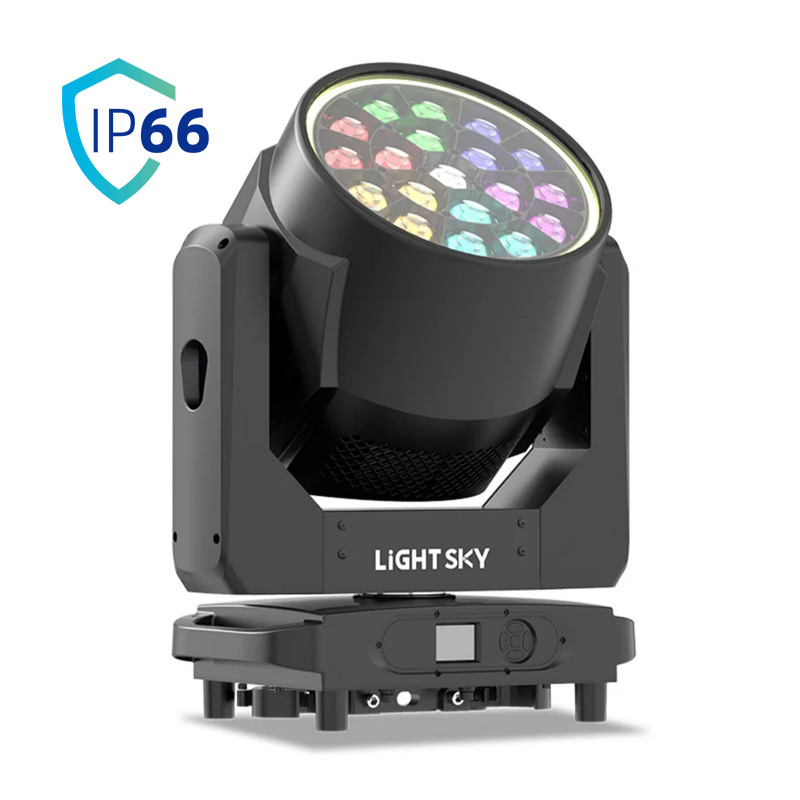
One practical example is LiGHT SKY AQUAPEARL-PRO II, which uses 19 × 40W RGBW LEDs, individually controlled LED sources, and a 5°–45° optical zoom. Its IP66 construction supports indoor and outdoor stage applications, while RGBW mixing provides a broad range of color treatments. These specifications give production teams options ranging from concentrated visual accents to wider washes across stage surfaces.
The fixture also demonstrates why optical flexibility can matter in a large venue. A narrower setting can add definition to a selected section, while a wider configuration can cover more scenery. Individual LED control further expands the possibilities for dynamic visual patterns without changing the physical position of the unit.
Building Depth Across A Wide Stage
Wide award stages can become visually uniform if every fixture points toward the same plane. Depth appears more naturally when different distances from the audience receive distinct treatments.
Backdrops are particularly useful in this respect. Subtle color shifts behind presenters can separate foreground action from scenic elements, while side illumination can reveal stage architecture without drawing attention away from the ceremony.
The relationship between light and surface texture deserves equal consideration. Dark scenic materials absorb much of the available illumination, whereas glossy panels may produce noticeable reflections. Testing angles during rehearsal helps technicians decide whether to soften, redirect, or narrow particular sources.
Making Programming Easier To Manage
A complex ceremony can contain dozens of lighting cues, so logical programming is valuable. Scenes can be grouped according to program sections rather than fixture types, allowing operators to think in terms of the event itself.
DMX-based systems remain common in professional production, while network-based control can be useful when larger lighting systems require more extensive data distribution. The appropriate setup depends on the venue, console, fixture count, and existing infrastructure.
As a stage lighting equipment supplier, we consider control flexibility alongside optical performance. At LiGHT SKY, our approach is to give production teams practical ways to shape scenes, adjust visual emphasis, and adapt lighting to the changing pace of an awards program.
Conclusion
Successful awards-night lighting does not require every moment to look spectacular. Stronger results often come from knowing when to simplify, where to add contrast, and how to let each program section develop its own visual character. A carefully planned LED wash moving head setup can support those changes while preserving stage clarity and audience focus. With thoughtful fixture placement, cue design, and color planning, we at LiGHT SKY view lighting as a flexible creative tool that can help large‑scale ceremonies feel structured, dynamic, and visually coherent.