Easy Visual Layers For Beat-Drop Moments With White Laser Light
Beat drops create some of the clearest opportunities for a lighting change because the audience already expects a shift in energy. White laser light can accentuate that transition through tightly defined beams, sudden changes in intensity, or layered effects that appear precisely with the musical phrase. At LiGHT SKY, we consider these moments from both the technical and artistic sides, looking at how fixture position, movement speed, stage depth, and music structure can work together.
Turning Musical Accents Into Visual Cues
Strong lighting does not require an effect on every beat. A more deliberate approach uses selected accents to establish a visual rhythm, leaving enough space between major changes for the audience to recognize each transition.
Short pauses before a drop can be especially useful. Lowering the overall stage intensity creates visual anticipation, while the following cue can introduce a wider composition, brighter beams, or stronger movement. Such contrast often feels more dramatic than simply increasing brightness throughout the song.
Programming should follow the arrangement rather than operate independently from it. A DJ set, live band performance, or choreographed show may contain different musical structures, so cue timing should be adapted during rehearsal instead of relying entirely on a generic sequence.
Building Depth With Beam Placement
Stage depth becomes more noticeable when beams originate from different angles. Rear fixtures can create shafts through haze, side positions may outline performers, and elevated units can provide a broader sense of scale. The combination creates layers without requiring every fixture to produce the same effect.
Distance also changes the apparent size of a beam. A narrow projection may look extremely precise from a long throw, whereas the same fixture positioned closer to the audience can create a more concentrated visual point. Designers should therefore consider throw distance before selecting movement patterns.
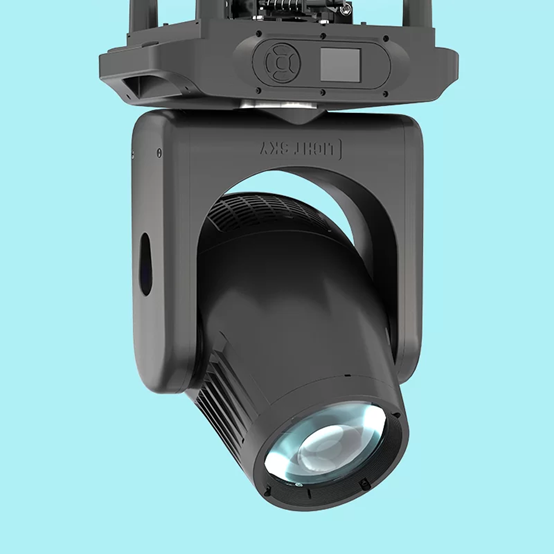
A laser moving head light can contribute to this layered approach because its directional output allows designers to define specific visual paths. Careful positioning remains important, particularly when performers, cameras, LED walls, and scenic elements share the same space.
Managing Compact Equipment Efficiently
Equipment dimensions can influence both rigging plans and creative possibilities. Smaller fixtures are often easier to position around existing structures, while manageable weight can simplify transportation and setup for touring productions.
MINI LASER AQUA measures 329 × 222 × 508 mm and has a net weight of 13.7 kg. Its compact format gives production teams another option when space is limited, while the carton dimensions of 410 × 290 × 625 mm and gross weight of 17.3 kg provide useful logistical information for transport planning. The model is designed for outdoor stage and entertainment applications, so installation should remain consistent with its specified environment.
Size alone, however, should not determine fixture placement. The available power distribution, rigging capacity, cable routes, maintenance access, and desired projection distance all deserve consideration before equipment is assigned to a position.
Designing The Drop Without Visual Clutter
A beat drop can tempt designers to activate every available effect simultaneously. Such an approach may create intensity, but it can also make individual changes difficult to distinguish. Visual hierarchy provides a better way to organize the moment.
One section might use beams as the primary effect, while another relies on movement or color. Prisms, gobos, and atmospheric effects can then appear selectively rather than continuously. This gives the lighting operator more room to build the show as the music develops.
The term laser moving head light covers fixtures capable of directional movement and laser-based visual effects, but the actual creative result depends heavily on programming. Movement curves, acceleration, fixture spacing, and cue duration all influence whether the effect feels smooth, sharp, expansive, or restrained.
Connecting Movement With Performance Energy
Lighting movement can mirror musical momentum without literally matching every rhythm. A gradual sweep across the stage may suit an extended build, whereas a rapid repositioning cue can emphasize a short transition. Alternating between these approaches keeps the visual language varied.
Performer location should also influence the programming. If dancers move across the stage during a drop, beams should frame the action instead of repeatedly crossing faces or blocking important visual details. Camera operators need similar consideration because intense beams can affect exposure and contrast.
At LiGHT SKY, we also consider how technical effects translate beyond the venue itself. Concerts are frequently recorded or streamed, meaning lighting decisions should work from both the audience viewpoint and the camera position.
Conclusion
Beat drops become more visually effective when lighting changes have a clear relationship with musical structure. Controlled intensity, layered beam positions, purposeful movement, and selective effects can create excitement without turning every cue into the same burst of activity. White laser light is particularly useful when a production calls for concentrated projection and distinct visual direction.
Good programming also depends on practical preparation, from fixture dimensions to rigging conditions and camera sightlines. The role of laser moving head light technology becomes more meaningful once those details are integrated into the creative plan. At LiGHT SKY, we use that balance of technical planning and visual judgment to help each transition feel intentional rather than simply louder or brighter.