Company Annual Meetings: A Beginner-Friendly Look at a 4-In-1 Profile Moving Head
Company annual meetings often combine presentations, awards, executive speeches, videos, and entertainment within a single program, so the lighting needs to change with the pace of the event. An LED BSWP 4-in-1 moving head spotlight can provide several visual functions without forcing the lighting plot into a complicated collection of fixture types. At LiGHT SKY, we see annual-meeting lighting as a balance between communication, atmosphere, stage architecture, and camera visibility rather than an exercise in using effects as frequently as possible.
Building A Clear Visual Foundation
The first task is deciding what the audience should notice at each stage of the meeting. During a keynote, attention generally belongs to the speaker and presentation screen, while an award segment may require more emphasis around the recipient. This difference gives the lighting plot a natural hierarchy.
Stage dimensions also influence fixture selection. A compact ballroom may need carefully controlled coverage to prevent light from spilling onto tables or reflective surfaces, whereas a large conference hall can accommodate longer projection distances and broader visual separation.
Background illumination deserves separate consideration. Keeping the rear stage slightly different from the presenter area can add depth without making the screen, branding wall, or scenic elements visually compete with the person speaking.
Using Beam And Profile Functions With Purpose
An LED moving head spotlight becomes particularly useful when different sections of an annual meeting call for different visual treatments. Narrow beams can introduce an award segment, while profile projection can frame scenic details or selected areas of the stage.
Beam movement should also correspond with the event’s rhythm. Slow positional changes can work during transitions, whereas faster movement may suit an entertainment section. Leaving fixtures static is sometimes the better choice, especially during important speeches where visual movement could become distracting.
Profile functions offer another creative option. Rather than illuminating an entire backdrop, shaped light can isolate architectural features, presentation areas, or decorative elements. Such selective treatment gives designers more control over where the audience’s attention settles.
Managing Color Without Overloading The Room
Color has a strong influence on how a corporate event feels. Cooler tones can create a restrained presentation environment, while warmer hues may work well during recognition moments or celebratory segments. The key is establishing relationships between colors rather than assigning a different color to every cue.
Screen content must remain part of the calculation. Bright graphics and video walls already contribute significant color and luminance, so stage lighting that is equally saturated may create visual competition. More moderate transitions can help maintain separation between live presenters and digital content.
Corporate identity can also be incorporated without making every cue look identical. Brand colors might appear during opening or closing moments, while neutral tones support speeches and presentations. This creates continuity while allowing the event to retain visual variety.
A Practical Fixture Example From LiGHT SKY
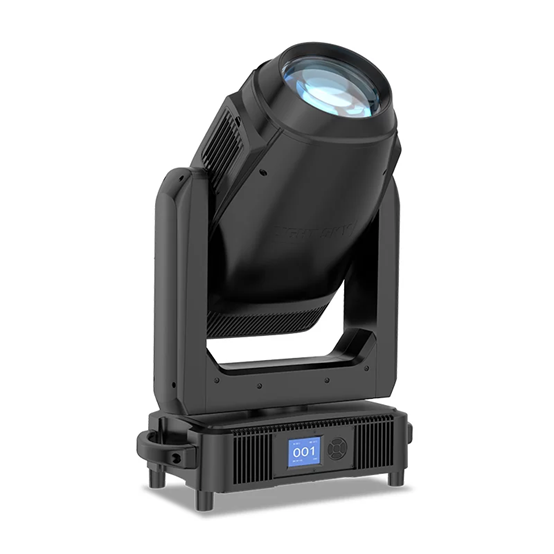
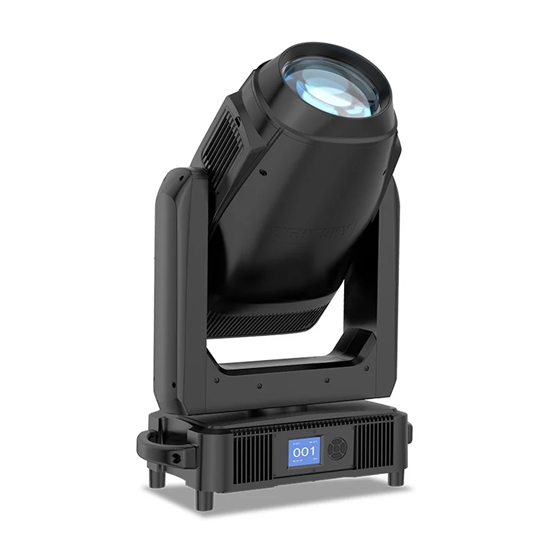
For indoor annual meetings that need several optical functions within one fixture, we offer SUPER SCOPE PLUS as an example of this approach. Its 180 mm high-precision lens is designed for sharp beam definition and clear projection, while two rotating gobo wheels provide additional pattern options with strong edge-to-center clarity. The fixture combines beam, spot, wash, and profile capabilities for professional indoor productions.
Its versatility can be useful when the program shifts repeatedly between corporate communication and stage entertainment. A concentrated projection can establish an entrance cue, profile functionality can shape a scenic area, and broader coverage can support performers. Rather than activating every feature simultaneously, designers can assign specific functions to specific moments.
Making Cue Programming Easier To Follow
An LED moving head spotlight works most effectively when the cue structure reflects the program itself. A lighting operator can group cues around keynote speeches, executive entrances, award presentations, employee recognition, performances, and closing remarks, giving every section its own visual character.
Timing should remain closely connected to stage action. A light change that happens slightly before an entrance can create anticipation, while a delayed transition may make the same movement feel disconnected. Rehearsals therefore provide useful opportunities to refine not only intensity but also the exact relationship between lighting and stage direction.
Camera testing is equally valuable. Annual meetings are often photographed or streamed, and a look that appears balanced from the audience may behave differently through a camera. Exposure, reflective surfaces, LED screens, and presenter positioning should all be reviewed during technical rehearsal.
Keeping The Final Look Professional
A polished corporate production rarely depends on maximum brightness or constant movement. Instead, contrast, spacing, timing, and restraint give each cue a reason to exist. The second LED BSWP 4-in-1 moving head spotlight reference in the lighting plan can represent a versatile fixture category, but its real value depends on how thoughtfully the designer assigns each optical function.
The same principle applies to an LED moving head spotlight: technical flexibility becomes meaningful when it supports the story of the meeting. Speakers need clarity, award recipients need emphasis, performers need room to move, and visual content needs sufficient separation from the stage lighting.
Conclusion
Successful annual-meeting lighting is ultimately about communication as much as spectacle. Thoughtful beam placement, selective profile work, measured color changes, and well-timed cues can help an event move naturally from business presentation to celebration without losing visual coherence. We at LiGHT SKY approach professional stage lighting with this practical perspective, using flexible equipment and considered programming to give production teams more ways to shape indoor corporate events while keeping every visual decision connected to the purpose of the program.