
A Simple Way To Bring White Laser Light Into Dramatic Show Openings
Dramatic show openings depend heavily on the first few seconds: the audience needs to understand where to look, while the lighting should establish the visual mood before the main performance begins. White laser light offers a distinctive approach because its narrow projection can create strong directional lines and atmospheric depth without relying entirely on broad stage illumination. At LiGHT SKY, we regard this type of opening as a balance between visual impact, cue timing, stage geometry, and audience comfort.
Defining The Visual Language Of An Opening
Strong opening sequences rarely need every lighting effect at once. A carefully selected beam direction can establish scale, while darker areas around the stage provide contrast and make the first major cue more noticeable. This principle applies particularly well to theatre productions, where scenery, performers, and projection content already carry important visual information.
Beam width also changes how an audience perceives distance. Narrow output can make a stage appear deeper, while broader illumination creates a more connected visual field. Designers can therefore create progression simply by changing projection characteristics between cues instead of introducing a completely different visual concept.
Another useful consideration is movement speed. Slow sweeps often suit suspenseful introductions, whereas faster directional changes can accompany music accents or dramatic reveals. The most effective sequence usually gives each transition a clear purpose rather than filling every silent moment with movement.
Creating Depth Without Overloading The Stage
Stage depth can be difficult to communicate in large theatres. Scenic elements may remain visually flat under uniform illumination, particularly when the backdrop and foreground receive similar brightness. Directional beams provide another layer that can separate these planes and add a stronger sense of dimensionality.
Color temperature contributes to the same effect. Neutral or cool white can produce a crisp architectural appearance, while warmer tones may soften scenic materials and create a more intimate atmosphere. Designers can combine these qualities across different sections of an opening rather than depending on color changes alone.
The relationship between beam intensity and surrounding darkness deserves equal attention. Excessive output may flatten the contrast that makes a beam visible in the first place. Controlled dimming allows the visual field to breathe, giving the audience a clearer perception of each programmed transition.
Introducing Laser Technology With Practical Control
We find laser-based fixtures differ from traditional lighting sources in both beam characteristics and visual perception. Their concentrated projections stay visually distinct over long distances, which is why we pay close attention to fixture positioning. We recommend operators fully consider audience sightlines, reflective surfaces, camera positions, and the spatial relationship between beam paths and onstage performers.
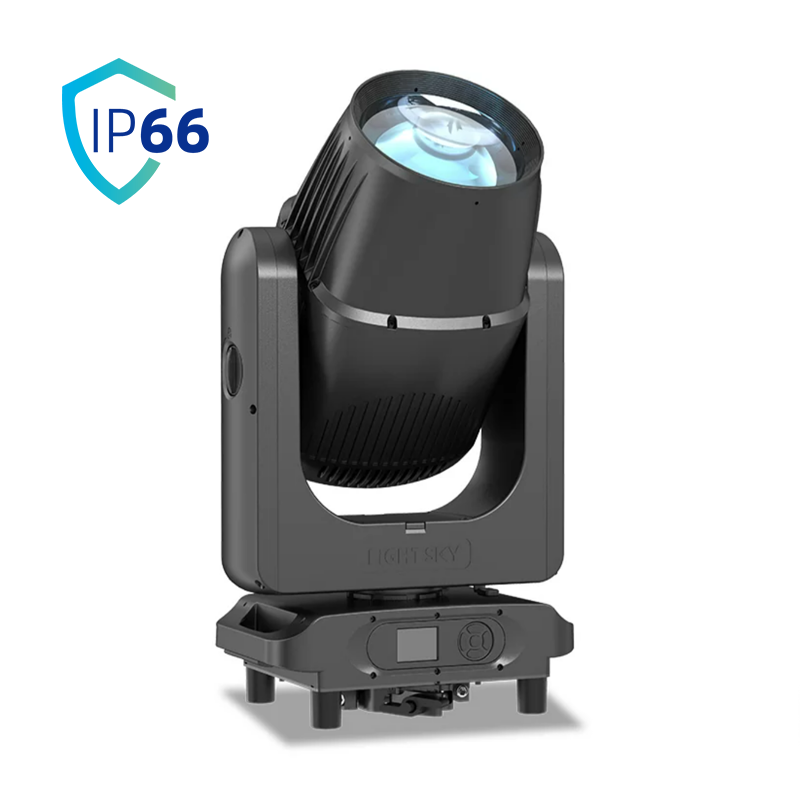
The MINI LASER AQUA from LiGHT SKY uses a 100W white laser source and combines ultra-narrow beam optics with dynamic colors, gobo effects, dual prisms, and IP66 protection. Its compact moving-head format is designed for outdoor stage and entertainment applications, giving programmers several ways to shape beam texture and movement within one fixture.
We find such capabilities can be useful during an opening sequence, yet restraint remains valuable from our perspective. A concentrated beam can already create a strong visual statement, so we should introduce additional color, gobo, or prism effects should be introduced according to the music and dramatic structure rather than simply because they are available.
Coordinating Lighting With Performance Cues
Opening cues often involve several departments working simultaneously. Audio may introduce the first musical phrase, video content may appear on a screen, performers may enter from different positions, and stage management may trigger a reveal. Lighting works best when its timing is connected to these events.
Cue construction can follow the dramatic arc. One look might establish the stage before the curtain movement, another can accompany the first performer, and a third may expand across the venue during the main reveal. This progression gives the audience a recognizable visual journey without requiring complicated programming.
Communication also becomes important during rehearsal. Theatre lighting manufacturers and production teams may approach equipment differently, but practical results depend on how fixtures behave within the actual venue. Testing cues from multiple audience positions can reveal unwanted glare, blocked beam paths, or visual conflicts with scenic elements.
Refining Texture, Contrast, And Movement
Texture provides another method of creating variety. Gobos can introduce patterns onto selected surfaces, while prisms can multiply concentrated projections into more complex arrangements. These effects become especially expressive during instrumental introductions or transitions where the stage does not yet contain much performer movement.
Focus should remain connected to the intended projection surface. Sharp patterns can emphasize architectural details, while softer transitions may suit atmospheric sections. Combining these changes with dimming creates visual depth without requiring constant repositioning.
White laser light can also function as a structural element rather than merely an effect. A defined beam can mark an entrance, frame a performer, or establish a central axis across the stage. Once that visual role has been established, subsequent cues can modify color, texture, or movement while retaining a recognizable connection to the opening look.
Building A Responsible Programming Approach
We believe laser fixtures require thoughtful programming, because their concentrated beams can appear far brighter than their physical size would suggest. Before rehearsals begin, we take full account of fixture placement, beam direction, venue configuration, and all relevant safety practices.
Programming teams can begin with the simplest possible cue and add complexity only where it improves the performance. This method makes troubleshooting easier and gives operators a clearer understanding of which parameters actually matter during each scene.
The wider lighting system should also retain enough contrast for the laser effect to remain distinctive. Flooding the entire stage with equally intense illumination may reduce the perceived definition of narrow projections. Balanced levels instead create space for individual cues to stand apart.
Conclusion
Dramatic openings gain strength when lighting changes feel connected to the performance rather than added as decoration. Directional projection, controlled contrast, deliberate movement, and carefully timed texture can establish atmosphere while preserving attention for performers and scenic elements. Theatre lighting manufacturers continue to explore different optical approaches, yet practical design still comes down to how intelligently each tool is used. At LiGHT SKY, we see white laser light as one part of that creative vocabulary, capable of adding definition and depth when its characteristics are matched carefully with the story, venue, and opening cue.