
A Practical Role For Professional Stage Lighting In Graduation Ceremonies
Graduation ceremonies combine formal speeches, emotional moments, group photographs, and large-scale audience movement, so the lighting needs to accomplish more than simply making the stage visible. A thoughtful stage lighting manufacturer can help event teams consider illumination as part of the ceremony’s visual structure, particularly where speakers, graduates, screens, and cameras share limited space. At LiGHT SKY, we believe the most effective approach begins with understanding what each part of the ceremony needs from the lighting rather than adding effects simply for visual impact.
Establish A Comfortable Visual Foundation
The audience may remain seated for a considerable period, making visual comfort an important consideration. Excessive brightness, direct glare, or constantly changing colors can become tiring during long speeches. A stable base level allows graduates and speakers to remain clearly visible while giving the production team enough room to introduce changes at significant points.
Stage depth also affects perception. Front illumination can provide facial visibility, while separate background layers add dimensionality to the stage. If both areas receive identical intensity, the scene may appear flat; excessive contrast, however, can make faces difficult to read. Balancing these layers gives the ceremony a more natural visual hierarchy.
A comfortable foundation allows the lighting to support the event without becoming a source of distraction.
Give Important Moments More Definition
Not every part of graduation deserves the same visual treatment. The opening procession, diploma presentation, student speeches, honorary recognition, and closing sequence each carry a different level of emotional significance. Distinct lighting states can help audiences perceive these transitions even when the physical stage remains unchanged.
Movement can be useful, but it should have a clear purpose. A beam sweeping across the room may create excitement during an opening sequence, yet the same effect could interfere with a graduate receiving a diploma. Careful cue timing keeps visual changes connected to the ceremony’s rhythm instead of interrupting it.
Subtle contrast often creates stronger emphasis than constant visual activity.
Use Wash Lighting To Shape The Stage
Large graduation stages frequently rely on LED screens or projection surfaces, which means the surrounding light must coexist with digital content. A broad, adjustable wash can help provide even color across scenic elements while leaving the central presentation area clear. Its value becomes especially apparent when the stage changes from a formal speech setting to a celebratory group moment.
An LED moving head wash light can provide adaptable coverage because its direction and color can be adjusted through the control system. Designers may use wider coverage for scenic backgrounds and more focused positioning for specific stage zones, depending on fixture optics and installation distance. The practical benefit comes from being able to reshape the lighting remotely as the ceremony progresses rather than relying entirely on fixed positions.
For indoor graduation productions, the fixture should be evaluated according to beam spread, movement range, color performance, control compatibility, and the physical dimensions of the venue.
Coordinate Light With Cameras And Displays
Graduation ceremonies are increasingly recorded, livestreamed, and photographed, making camera compatibility an important part of lighting design. A stage can appear balanced to the audience while producing overly dark faces or distracting highlights on camera. Rehearsal footage can reveal these differences before the ceremony begins.
Screen brightness creates another challenge. A large LED wall can become a dominant light source, especially when displaying white backgrounds or bright graphics. Rather than competing with the screen, stage illumination can be adjusted around its content. Keeping presenters sufficiently separated from the brightest visual areas also helps cameras retain clearer subject detail.
A camera-conscious plan gives the ceremony greater consistency across the venue, livestream, and photographs.
Select Equipment According To Venue Conditions
A university auditorium, outdoor stadium, convention center, and theater require different technical approaches. Ceiling height, rigging points, throw distance, ambient illumination, power capacity, audience arrangement, and noise requirements all affect equipment selection. These factors should be reviewed before the fixture list is finalized.
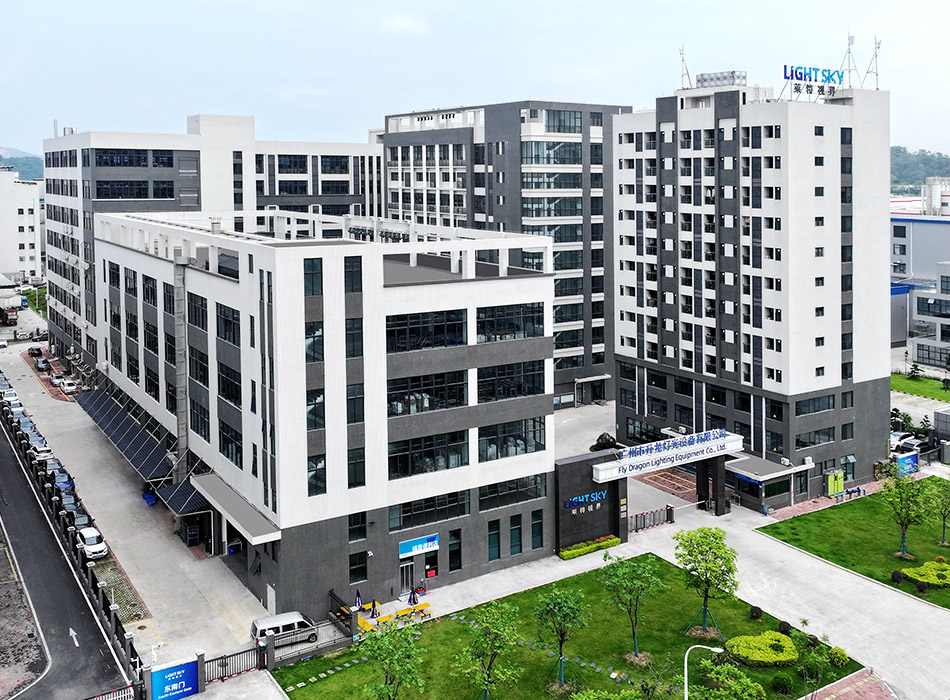
The same principle applies to supplier evaluation. At LiGHT SKY, we combine R&D, production, distribution, OEM, and ODM capabilities, with our company founded in Guangzhou in 1993. Our manufacturing and R&D center covers 50,000 m², and we have accumulated more than 200 patents. Such resources form part of the broader technical context that event teams can consider alongside fixture specifications.
Practical planning becomes easier once the venue’s physical limitations are translated into measurable lighting requirements.
Conclusion
A graduation ceremony already carries its own emotional weight; lighting does not need to manufacture that feeling. Its practical role is to make the stage readable, separate important moments, complement screens, and provide a consistent visual experience for both the audience and cameras. A carefully designed system can remain understated during speeches and become more expressive at moments that naturally call for celebration.
At LiGHT SKY, we approach event lighting by connecting technical characteristics with the actual conditions of each production. Teams evaluating an LED moving head wash light can consider coverage, movement, color, control, and placement alongside the venue layout and program schedule. Working with a stage lighting manufacturer becomes more productive when those needs are established first, allowing equipment to serve the ceremony rather than dictating its visual direction.