
Is a Higher CRI Better on Stage?
Is a Higher CRI Better on Stage?
Key Takeaways:
- A higher Color Rendering Index (CRI) does not guarantee better stage lighting; maximizing CRI often requires a measurable reduction in total lumen output.
- Standard CRI (Ra) is an average of eight pastel colors and explicitly excludes deep red (R9), which is critical for rendering natural skin tones on stage.
- Broadcast environments and key lighting require a minimum CRI of 90, while heavy-duty outdoor concert washes operate efficiently between CRI 70 and 85.
- Mixing fixtures with differing CRI values within the same performance zone will create visible color inconsistencies during dimming cues.
- Professional specifiers should evaluate IES TM-30 (Fidelity and Gamut) alongside CRI for a complete photometric profile.
A higher CRI is not universally better for stage lighting. While high CRI (90+) is essential for front-of-house key lighting, theatrical skin tones, and broadcast capture, achieving extreme color fidelity typically requires a reduction in raw lumen output.
For outdoor festival rigs, aerial beam effects, and deep-saturated concert washes, a lower CRI fixture that delivers higher maximum output and rapid optical movement is the correct engineering choice.
Specifying stage lighting requires matching the photometric parameters to the specific application, rather than simply pursuing the highest CRI number on a datasheet.
What Does CRI Measure in Stage Lighting?
Color Rendering Index (CRI) measures how accurately an artificial light source reveals the true colors of objects compared to a natural reference light source of the exact same color temperature. It does not measure brightness, beam angle, or color temperature.
The metric operates on a scale of 0 to 100. The closer a fixture scores to 100, the more closely its output mimics natural daylight or a blackbody reference. However, specifiers must understand what CRI does not measure:
- Light Output (Lumens): CRI operates independently of brightness. A fixture with a CRI of 95 can yield a low lumen output, while a CRI 70 fixture can yield a high total lumen output.
- Beam Coverage: Lens spread, zoom ranges, and wash or spot classifications do not relate to color rendering.
- Correlated Color Temperature (CCT): CRI measures color accuracy, whereas CCT (measured in Kelvin) measures color appearance (e.g., warm 3000K vs. cool 5600K). High CRI is achievable at both ends of the CCT spectrum.
- Saturation Preference: CRI evaluates mathematical accuracy to a standard. It does not measure creative color saturation.
→ How to Improve LED Stage Light Performance
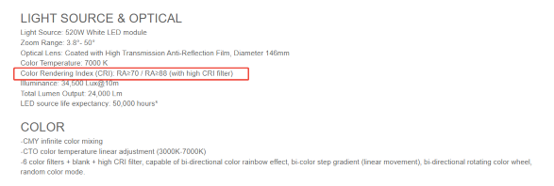
Why the General CRI (Ra) Number is Incomplete
The standard CRI (Ra) number on a datasheet is an average of eight moderately saturated pastel colors (R1–R8). It excludes highly saturated colors, notably deep red (R9), which leads to incomplete performance data.
Relying solely on the standard Ra value creates operational risks on stage. Since red is excluded from the standard Ra average, a fixture can score an Ra of 90 but yield a low R9 value (e.g., <50).
When illuminating a performer in a red costume under that light, the fabric will appear brown or muted. Professional designers evaluate secondary metrics to ensure accuracy:
- The R9 Value: Always evaluate the specific R9 rating alongside Ra to ensure accurate rendering of saturated reds and human skin tones.
- IES TM-30: A standard utilizing over 99 color samples. It yields an Rf (Fidelity Index) for accuracy and an Rg (Gamut Index) for saturation levels.
- SSI & TLCI: Broadcast-specific metrics used to evaluate on-camera color performance.
What is a Good CRI for Stage Lighting?
A “good” CRI is contributed in the fixture’s placement and purpose. Key lights and broadcast setups require CRI 90 or above, while effect lighting and background washes perform effectively at CRI 80 or below.
Use the following parameters to match CRI performance to the correct stage application:
| CRI Level | Color Performance | Best Stage Applications |
|---|---|---|
| CRI 95+ | Premium color rendering | Principal performer key lights, front-of-house (FOH) positions, close-up stages, and high-definition broadcast studios. |
| CRI 90+ | Professional color accuracy | Drama productions, musicals, professional television broadcasts, and color-critical theatrical environments. |
| CRI 80–89 | Standard commercial accuracy | General stage wash lighting, background scenery effects, and budget-constrained venue positions. |
| Below CRI 80 | Reduced color fidelity | Stylized effects (e.g., haze lighting, back-of-house aerial beams) where natural color accuracy is irrelevant. |
When Does High CRI Matter Most?
High CRI is non-negotiable when illuminating human subjects, detailed set pieces, and broadcast environments. In these scenarios, lower CRI fixtures distort visual data that digital cameras and the human eye process.
While high-intensity, low-CRI washes are sufficient for outdoor concert applications where energy and intense saturation take precedence, high CRI is required in specific environments:
- Performer Skin Tones & Makeup: Low-CRI fixtures distort complex skin undertones, making actors look pale or green. It also alters the appearance of precise stage makeup.
- Costume Integrity: High CRI preserves the costume designer’s exact fabric color-grading intentions, preventing blue fabrics from shifting green.
- Scenic Realism: Set designers use precise earth tones and gray variations. Low-CRI light turns these textured layers into flat, two-dimensional blocks of color.
- Camera Capture: Digital sensors are highly sensitive to color distortion. Minor color imbalances appear magnified on live broadcasts, livestreams, or archival recordings.
How Does LiGHT SKY Stability Color Output During Low-Level Dimming
LED sources frequently experience output deviations in color and color temperature (CCT) during low-intensity dimming cues. Mitigating this requires hardware-software calibration to unify the dimmer response across the entire rig.
Maintaining high CRI and consistent color coordinates is challenging when fading a lighting cue to a blackout. As the LED driver reduces power, standard fixtures often exhibit low brightness inconsistencies.
To resolve this, modern LED fixtures like the LiGHT SKY SUPER SCOPE COLOR utilize LiGHT SKY introduced the integrated calibration systems — iCC™ (LiGHTSKY Colorfy Calibration), which is employed to AQUAPEARL-PRO II (Outdoor LED Beam Wash) and SUPER SCOPE COLOR (LED Spot).
This high-precision system facilitates closed-loop feedback control alongside hardware-software collaborative algorithms. By performing independent data programming and calibration for the driver chip within each fixture, the iCC™ system unifies the dimmer response, color coordinates, and CCT output curves. All contribute to the stable and accurate CRI, even at minimal intensity levels.
→ More on LiGHT SKY’s Stage Lighting Technological Innovation Framework
Pro-Tips for Stage Designers
Specifying fixtures requires balancing budget constraints with technical requirements. Prioritize high-CRI fixtures for key lighting and maintain consistent CRI levels within individual performance zones.
Follow these operational guidelines when designing a rig or purchasing fleet inventory:
- Maintain Cohesive Color Performance: While it is not strictly necessary for every fixture illuminating a zone to share the exact same CRI rating, their overall color rendering capabilities should be closely matched.
- Optimize Capital Expenditure: Invest the budget into high-CRI (95+) fixtures for key lights, side profiles, and FOH positions. Allocate lower-CRI (80–89) fixtures for backlights, cycloramas, and general ambient washes to manage costs effectively.
- Test Dimming Behavior: LED engines can experience a color rendering shift at low dimming levels. Test fixtures at the exact brightness percentages they will operate at during the event.
- Evaluate the Trade-Off: For large-scale touring rigs, raw lumen output and rapid pan/tilt movement often take priority over minor margins in color accuracy. Determine if the application requires output or fidelity before specifying the hardware.
How to Manage CRI for Your Next Rig?
LiGHT SKY manufactures a range of professional stage lighting engineered to meet these distinct demands, from the high-precision SUPER SCOPE COLOR utilizing iCC™ calibration to high-intensity IP66 moving heads built for maximum aerial output.
[Contact LiGHT SKY today] for your next large-scale touring deployment or venue integration.Reference
- TARGETTI USA – TM-30: The New Standard In Color Rendering
- Wikipedia — Color rendering index
- LUMENS — What Is Color Rendering Index (CRI) & A Guide to High-CRI Lighting