
Why an LED Wash Moving Head Is Worth Considering for Product Launches
Product launches rely heavily on timing, presentation, and visual focus. Every reveal, keynote, demonstration, and transition needs its own atmosphere without making the production feel unnecessarily complicated. An LED wash moving head can support this flexibility by combining color, coverage, and directional movement within one lighting approach. At LiGHT SKY, we see value in fixtures that give production teams more creative options while keeping programming practical.
Match Lighting Movement With Product Reveals
A product reveal usually has a clear visual sequence: anticipation builds, attention shifts toward the stage, and the new product becomes the focus. Lighting can reinforce these stages through changes in intensity, position, and beam spread rather than relying on constant effects.
During the opening section, broader illumination can establish the stage environment. As the presentation approaches its key moment, tighter positioning may draw attention toward a display area, presenter, or product platform. The transition should feel connected to the presentation instead of appearing as an unrelated lighting effect.
Movement speed can also influence perception. Slow pan or tilt changes tend to create a controlled, sophisticated atmosphere, while faster movement may suit energetic launches with music or audience interaction. Selecting the appropriate pace helps the lighting follow the character of the brand presentation.
Create More Flexible Stage Coverage
Product launches rarely remain visually static. Speakers may move between podiums, demonstration tables, screens, and central platforms. A moving head beam wash can respond to these changes more easily than a fixed fixture because its direction can be adjusted through programming.
Stage geometry should guide fixture placement. Designers can examine the distance between lighting positions and presentation areas, then determine which angles provide useful coverage. This planning prevents unnecessary movement and helps maintain consistent illumination as the event progresses.
Different sections may require different visual scales. Wider coverage works well during group presentations, while more concentrated positioning can emphasize a demonstration. Such changes give the stage a sense of progression without requiring a completely different lighting setup for every segment.
Use Pan And Tilt With Greater Precision
Motion parameters become particularly important when lighting cues need to land at specific moments. A fixture that can move through a substantial range gives programmers more room to create varied stage compositions, provided those movements are planned around the event rather than used continuously.
Precision also matters during rehearsals. Small positioning differences can change how a presenter, product display, or screen appears under the light. Fine control makes it easier to adjust cues according to the actual stage layout and camera perspective.
For larger productions, movement can be coordinated across multiple fixtures. One group may reposition toward the main stage while another creates background depth, producing a layered visual transition rather than having every fixture perform the same action.
Applying AQUAPEARL-PRO II to Product Launch Lighting
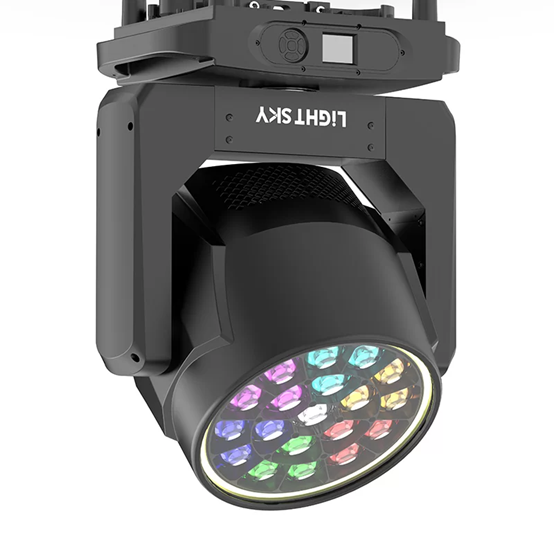
AQUAPEARL-PRO II provides 540° pan movement and 218° tilt movement, with 8-bit and 16-bit precision scan options on both axes. Its automatic error-correction reset function supports practical operation, while a fixed lock is provided for the tilt axis. These movement capabilities give programmers useful flexibility when stage layouts change between presentation sections.
At LiGHT SKY, we consider pan and tilt as compositional tools rather than specifications that need to appear in every cue. A broad opening position can establish the full stage, followed by a carefully programmed repositioning toward a demonstration zone. Later, the fixture can return to a wider arrangement as the presentation moves back into a general discussion.
The distinction between movement and coverage is worth remembering. Moving the fixture does not automatically create a stronger visual result; the destination, timing, and relationship with other lighting elements matter just as much. Rehearsal remains essential for finding positions that support presenters and products without creating unnecessary visual activity.
Coordinate Lighting With Screens And Presentation Content
Modern launches often feature large LED displays, product animations, countdown graphics, or live camera feeds. Lighting cues should account for these elements because excessive brightness or movement near a screen can make the visual composition feel crowded.
Screen content can also provide useful timing references. A countdown might gradually shift the lighting state, while a product animation could coincide with a color or position change. Such coordination makes the technical elements feel like parts of one presentation rather than separate systems.
Camera framing deserves attention as well. A lighting position that looks balanced from the audience may appear different in a close-up shot. Production teams can review camera feeds during rehearsal and adjust pan, tilt, intensity, and placement accordingly.
Keep The Cue Structure Easy To Adapt
A product launch can change quickly during technical rehearsal. Presentation timing may shift, a speaker may use a different stage position, or the reveal sequence might be shortened. Flexible programming makes these adjustments easier to manage.
An LED wash moving head can be assigned different roles throughout the program instead of remaining tied to one fixed look. It might illuminate the presentation area during a keynote, shift toward a product platform during a reveal, and return to broader stage coverage for a closing session.
The strongest cue lists are not necessarily the longest. Designers can identify the event’s important moments and give those sections meaningful changes, while keeping supporting cues simpler. This creates a clearer visual hierarchy and leaves room for spontaneous adjustments.
Conclusion
Product-launch lighting works best when technology supports the presentation instead of becoming the presentation itself. Thoughtful movement, carefully chosen positions, coordinated screen interaction, and adaptable cues can help create visual changes that feel purposeful. A well-planned moving head beam wash setup offers useful flexibility when the event moves between speeches, demonstrations, reveals, and performances.
We maximize the value of lighting movement by designing it to respond closely to an event’s structural rhythm. At LiGHT SKY, we uphold this practical design philosophy when developing professional lighting solutions. We enable production teams to refine fixture positioning and timing based on real-stage conditions, rather than pursuing exaggerated visual effects blindly.