When White Laser Light Makes Sense For Countdown Sequences
Countdown sequences depend on anticipation, rhythm, and one unmistakable visual destination. Mini laser stage lighting can contribute to that progression when the design calls for concentrated beams rather than constant scenic brightness. Instead of filling every second with effects, lighting programmers can build visual tension through contrast, movement, timing, and carefully reserved accents. At LiGHT SKY, we make these decisions from both production and technical perspectives, paying attention to how lighting interacts with screens, performers, sound, and the audience’s sightline.
Building Tension Before The Numbers Reach Zero
The visual language of a countdown should evolve gradually. Early cues might remain relatively restrained, allowing the audience to recognize that something is developing without revealing the strongest effect too soon. Subtle changes in intensity, direction, or beam position can establish a rhythm that becomes increasingly noticeable as the final seconds approach.
Contrast is particularly useful in this situation. If every fixture operates at high intensity throughout the sequence, the final cue has less room to create visual distinction. Reducing surrounding illumination before an important transition can make a concentrated projection appear more pronounced without requiring excessive output.
Color provides another layer of control. Neutral tones may communicate precision, while saturated hues can introduce excitement or signal a change in the sequence. White laser light is especially distinctive against darker scenic environments, so its use can be reserved for selected beats rather than treated as continuous illumination.
Matching Beam Behavior With Music
Lighting becomes more convincing when its movement follows the structure of the soundtrack. A slow sweep may suit an extended musical build, while a short directional change can coincide with a percussion hit or numerical transition. The objective is not to synchronize every lighting action to every sound, but to establish meaningful relationships between major cues.
Rapid movement can create energy, yet speed alone does not necessarily improve a countdown. Excessive pan and tilt activity may compete with presenters, graphics, or athletes entering the stage. A measured trajectory often provides enough motion while allowing the audience to understand where the visual focus is moving.
During the final sequence, mini laser stage lighting can function as a punctuation device. A concentrated beam appearing at a carefully selected moment may have more impact than repeated flashes throughout the entire program. This principle also makes programming easier to follow during rehearsals because each effect has a defined purpose.
Planning The Technical System
We find creative ideas still depend on practical infrastructure. Before we begin programming, production teams need to examine available power, signal distribution, mounting positions, control channels, fixture spacing, and the physical limitations of the venue. These factors influence how many units we can deploy and where we can position them safely.
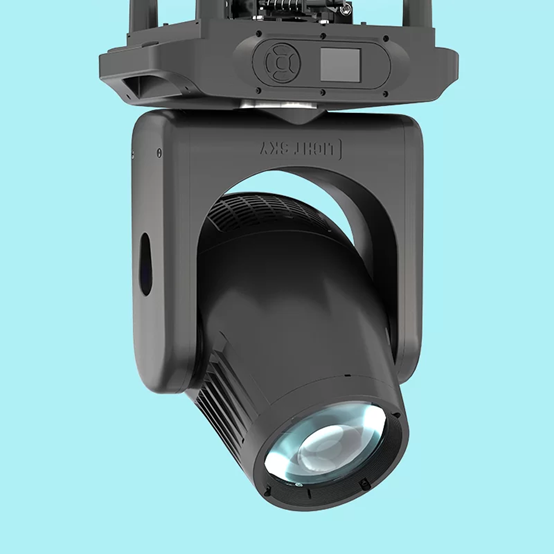
We regard MINI LASER AQUA as a useful example of the specifications we should review during preparation. Its input voltage is AC 100–240V at 50/60Hz, while maximum power consumption is 212W. The fixture has a power factor of 0.94, with maximum current listed as 2.12A at 100V and 0.94A at 220V. We note these figures give technicians practical references when calculating electrical capacity and distributing fixtures across the system.
Network and control planning deserve equal attention. A countdown may contain dozens of tightly timed cues, so consistent addressing and clear channel organization can make adjustments considerably easier. White laser light should therefore be considered within the entire control architecture instead of being programmed as an isolated visual element.
Using Space Without Overloading The Stage
Stage dimensions strongly influence how beams are perceived. A narrow venue may require less aggressive movement because projections can cross the audience’s visual field quickly, whereas a larger room can accommodate broader trajectories and greater separation between fixtures.
Haze is another important consideration. It reveals the path of a beam through the atmosphere, making direction and movement more visible. Too little haze can reduce beam definition, while excessive haze may soften other scenic details and affect cameras. The appropriate level depends on the room, ventilation, production requirements, and desired visual density.
A useful programming method is to divide the stage into visual zones. One area can carry background texture, another can frame the central screen, and a third can provide the main countdown accent. This creates hierarchy without requiring every fixture to change simultaneously.
Shaping The Final Visual Release
The last few seconds deserve a different treatment from the earlier buildup. Designers can gradually simplify the stage picture as the countdown approaches zero, reducing secondary effects so the final transition feels visually significant.
Intensity does not have to increase continuously. Instead, a short blackout, directional shift, color transition, or sudden beam appearance can provide the sense of release. The choice depends on the show’s tone and whether the next moment involves a logo reveal, performer entrance, music drop, or fireworks-style visual sequence.
Mini laser stage lighting can support this type of progression when the effect is integrated with the broader cue design. Rather than asking one fixture to carry the entire sequence, programmers can assign distinct responsibilities across wash, beam, spot, screen content, and atmospheric elements.
Conclusion
A memorable countdown is rarely built from one effect alone. Its strength comes from pacing: quiet moments create space, intermediate cues establish expectation, and the final visual change provides resolution. White laser light can add definition to that structure, particularly when concentrated projection is more appropriate than broad illumination.
At LiGHT SKY, we treat technical specifications, stage geometry, programming logic, and creative intent as connected parts of the same lighting conversation. Thoughtful mini laser stage lighting can then become a precise visual accent rather than another layer competing for attention, giving the countdown a cleaner progression from its opening cue to the final release.