SUPER SCOPE PLUS: Practical Profile-Framing Basics for Flexible Theatre Lighting
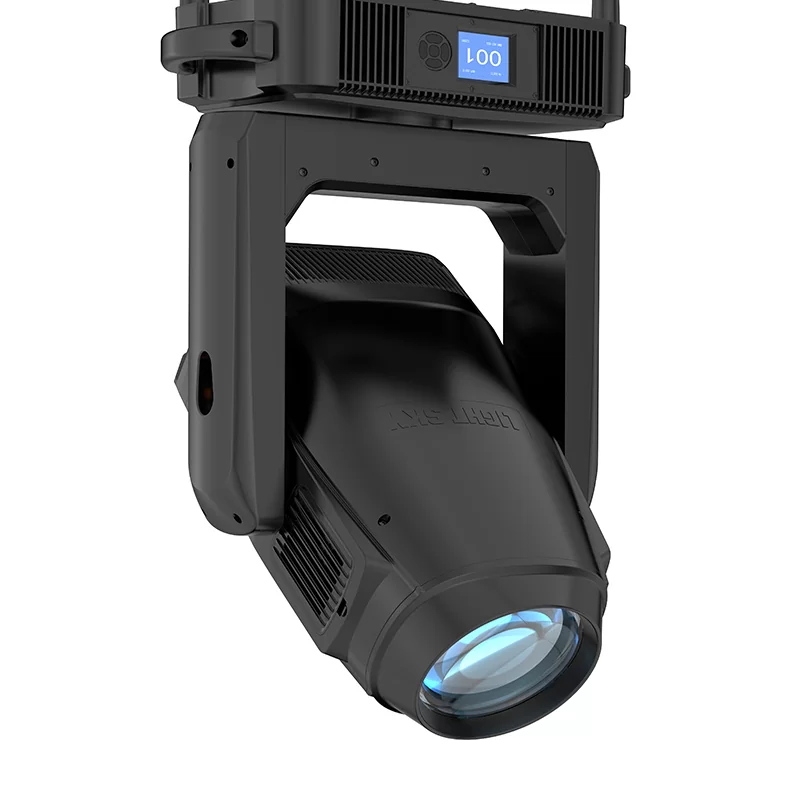
Theatre productions often need lighting equipment to perform different visual tasks without making the lighting system unnecessarily complicated. Beam projection, spot coverage, wash effects, and profile shaping may all be required during one production. At LiGHT SKY, we introduce SUPER SCOPE PLUS as an LED BSWP 4in1 moving head spotlight that combines these four functions with a framing system designed for controlled light shaping.
Why Profile Framing Matters on a Theatre Stage
Profile framing is mainly about controlling where light falls. Rather than illuminating a broad area without defined boundaries, a framing system allows operators to shape the beam around performers, scenery, architectural elements, or selected stage areas.
This distinction becomes useful when a production requires clear separation between lit and unlit sections. A properly adjusted profile beam can help reduce unwanted spill and make the lighting position easier to coordinate with the scenic design.
For an LED BSWP 4in1 moving head spotlight, framing is also connected with versatility. Since one fixture can switch between beam, spot, wash, and profile functions, the same lighting position can serve different purposes as a scene changes.
Distinguishing Lighting Functions for Theatre Applications
Beam, spot, wash, and profile functions address different lighting requirements. Beam effects generally emphasize concentrated projection, while spot functions provide a more focused lighting treatment for selected areas or subjects.
Wash functions are associated with broader illumination, making them useful when a larger section of the stage needs coverage. Profile functions instead concentrate on controlled shaping, where the outline and direction of the light become important.
For theatre teams, understanding these distinctions helps when planning fixture positions. A theatre lighting supplier should therefore be evaluated not only by the number of fixtures offered, but also by how clearly each fixture’s functions correspond with actual production requirements.
The Role of a Framing System
SUPER SCOPE PLUS uses a four-blade framing system. According to the supplied specifications, each blade supports eight-direction movement, while the framing system provides ±55° rotation for beam shaping. The page describes this system as supporting sharp, distortion-free shaping.
This type of control gives operators more flexibility when the lighting area needs a specific boundary. Instead of relying only on pan, tilt, or zoom, the beam itself can be adjusted through the framing blades.
Such control can be particularly relevant for theatre applications where scenery, curtains, set pieces, and performance areas create defined visual boundaries. The framing function can then become part of the programming process rather than simply an additional effect.
Optical Range and Projection Control
Framing works alongside the optical system. SUPER SCOPE PLUS is specified with a 180 mm optical lens and a zoom range of 5.5° to 52°. The page also lists a total lumen output of 41,000 lm and an illuminance specification of 28,300 lux at 10 m.
A wide zoom range gives operators room to change the beam from a relatively narrow projection to broader coverage. This matters when the same fixture is expected to support different stage positions or production requirements.
The practical value comes from coordinating zoom, framing, focus, and movement rather than treating any one parameter as sufficient on its own. Theatre lighting design depends on how these controls work together within the stage environment.
Building a Flexible Control Approach
A flexible fixture also needs to integrate with the lighting control system. SUPER SCOPE PLUS supports DMX512, RDM, Art-Net, and sACN, with 43-channel and 55-channel control configurations listed on the product page.
For operators, this means the fixture can be incorporated into different control workflows depending on the production setup. Framing positions, color changes, zoom adjustments, effects, and movement can be coordinated through programmed control rather than handled as isolated manual changes.
The fixture also includes a 0–100% linear electronic dimmer, electronic strobe control, CMY color mixing, and linear CTO from 2800K to 6800K. These functions give programmers additional parameters when building cues for different scenes.
Other Features That Support Scene Changes
The optical and effects systems extend beyond basic profile operation. The fixture includes two rotating gobo wheels, with each wheel holding seven interchangeable gobos, as well as an animation wheel for projection effects.
It also provides a four-facet prism and a four-linear prism system, along with two frost systems and an electric iris with a 5–100% linear adjustment range. These functions allow the fixture to move between more defined and more diffused visual treatments.
From a production-planning perspective, these controls are most useful when they have a clear purpose in the lighting design. Flexibility does not mean every effect needs to be used; it means the available functions can be selected according to the requirements of each scene.
Applying Profile-Framing Basics to Theatre Work
For our theatre projects, we start with the required coverage and beam shape rather than focusing on the feature list alone. We first identify where controlled framing is needed, then consider zoom range, movement, color control, and effects as supporting functions.
As a theatre lighting supplier, we consider fixture specifications alongside the intended stage layout and control environment. This approach helps us evaluate whether a multi-function moving head can reduce the need for separate fixture types in particular positions.
At LiGHT SKY, we developed SUPER SCOPE PLUS to bring beam, spot, wash, and profile functions into one moving-head platform. It features a four-blade framing system, 180 mm lens, 5.5°–52° zoom range, multiple control protocols, and several optical effects. For theatre applications with profile-framing requirements, we can use these documented functions as a practical basis for evaluating how the fixture fits into a production’s lighting plan.