
Making Trade-Show Presentations More Dynamic With Professional Stage Lighting
A trade show presentation has a difficult visual task: attract attention without distracting visitors from the message. Product demonstrations, technical explanations, executive speeches, and brand videos may all share the same booth or presentation area, so the lighting needs to adapt as the content changes. A capable stage lighting manufacturer can help planners think beyond basic brightness by considering beam direction, contrast, color, timing, and audience sightlines. At LiGHT SKY, we see these elements as practical tools for giving a presentation greater structure while keeping the focus on the products and people being presented.
Create A Visual Focus Within A Busy Exhibition Hall
Trade-show floors rarely provide a quiet visual environment. Neighboring booths may use large displays, moving graphics, illuminated signs, and video walls, creating considerable competition for visitors’ attention. Rather than responding with maximum brightness, a presentation area can use contrast to establish its own visual boundaries. A darker surrounding space paired with controlled illumination on the speaker or demonstration zone may make the stage easier to recognize from a distance.
The physical arrangement matters just as much. A product placed too close to a bright screen can lose definition, while an audience seated directly beneath an intense beam may experience glare. Separating the presenter area, product display, background graphics, and audience space gives each element a clearer role. Even a compact booth can benefit from this layered approach because visual hierarchy does not necessarily depend on a large lighting rig.
A successful exhibition presentation begins by deciding what visitors should notice first, second, and third.
Use Light To Support Different Presentation Formats
A technical product demonstration has different visual requirements from a company introduction. During a specification explanation, steady illumination may be preferable because visitors need to read graphics and observe the presenter. A product reveal, however, can use a controlled change in intensity or direction to create a clear transition. These differences can be programmed into a small number of lighting cues rather than turning every section into a visual spectacle.
We regard color as another valuable design layer. We incorporate corporate brand colors within backgrounds or transitional segments, while we maintain neutral illumination for human faces and physical products to guarantee visual clarity. Excessive color saturation can distort the appearance of materials, packaging and surface finishes, especially when captured by cameras. For this reason, we test color settings against real‑world products instead of selecting colors merely based on brand guideline documents.
The objective is not constant visual movement; it is a lighting sequence that responds naturally to the presentation’s changing purpose.
Understand What Moving Fixtures Can Contribute
We value lighting flexibility greatly when a single exhibition space hosts multiple presentations in one day. We use moving head lights to re-route illumination across different presentation zones, adjust beam coverage, and create diverse visual states without repositioning the fixtures on site. In our practice, the practical value of these fixtures depends on venue conditions, optical range, control systems, and the projection distance between fixtures and target subjects.
At LiGHT SKY, we manufacture equipment for professional stage and entertainment applications, with product development supported by our R&D and manufacturing capabilities. Take the SUPER SCOPE II as an example. We work with this fixture that integrates beam, spot, wash and profile capabilities and is powered by a 520W white LED module. According to official specifications, it delivers a 3.8°–50° zoom range, 20 000 lm total luminous output, and is fitted with a 140 mm high‑transmission coated lens. We note that this model is designed for professional indoor‑only deployment and not for outdoor scenarios. Its performance characteristics fit well within controlled exhibition and presentation environments where flexible optical coverage is required.
The important lesson is to assess optical characteristics against the booth layout instead of assuming that a more elaborate fixture automatically creates a better presentation.
Keep Technology From Overpowering The Message
We find trade‑show audiences often make quick judgments. Visitors may spend only a few seconds deciding whether to stop, and once they enter the presentation area, we believe they need to understand the message without unnecessary visual distractions. We note that rapid movement, intense beams, or frequent color changes can compete with a speaker if we use them without a clear purpose.
Screen content should receive similar consideration. Large LED displays already produce substantial visual activity, so the surrounding lighting can remain comparatively restrained. A presentation becomes easier to follow when the background supports the speaker rather than constantly demanding attention. Lighting operators can also reduce unnecessary changes during detailed explanations and introduce stronger effects only at meaningful transitions.
Visual energy works best when it creates emphasis rather than visual noise.
Plan Around Rehearsal And Visitor Movement
Unlike a theater, a trade-show booth may have people entering and leaving from several directions. Visitors can stand close to the stage, approach from the side, or watch from across the exhibition aisle. Fixture positions and beam paths therefore need to account for changing sightlines instead of assuming a fixed audience position.
Rehearsal provides an opportunity to test these conditions. The production team can walk through the presentation from several viewing points, check reflections on product surfaces, examine camera footage, and adjust cue timing. Technical factors such as power availability, rigging limitations, control connections, and fixture noise should also be reviewed before the event opens.
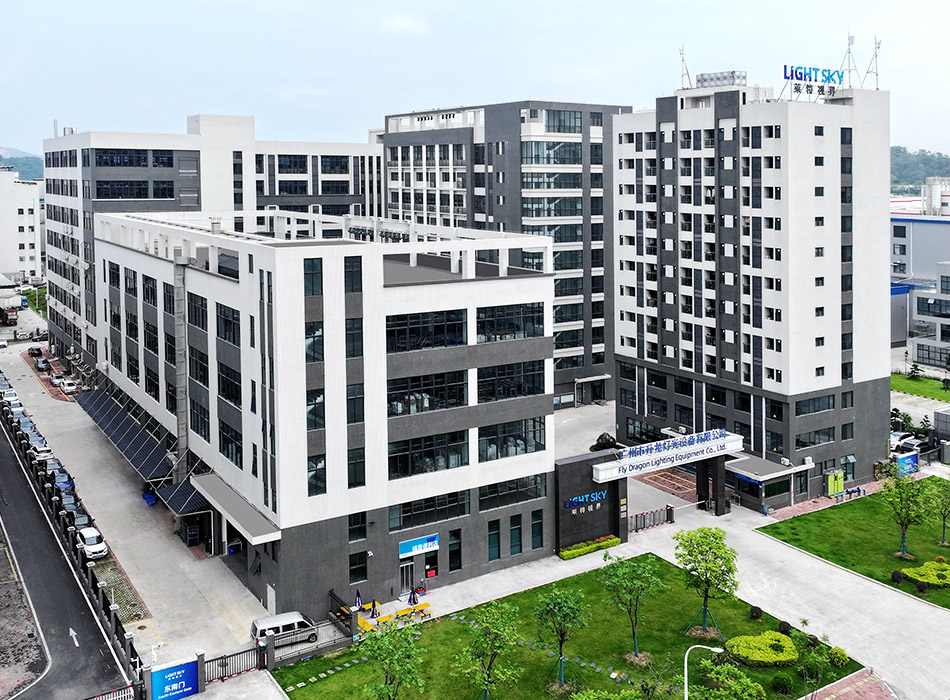
At LiGHT SKY, we combine R&D, production, distribution, OEM, and ODM capabilities, and our company was founded in 1993. We also hold more than 200 patents and operate a 50,000 m² factory and R&D center. Our experience across professional lighting projects gives us a practical perspective on how equipment characteristics interact with real presentation environments.
Conclusion
A trade-show presentation does not need concert-style effects to become visually engaging. A carefully planned combination of direction, contrast, color, timing, and fixture placement can make demonstrations easier to follow while giving the exhibition space a distinct visual character. The most useful decisions usually emerge after the presentation format, booth dimensions, audience movement, screens, products, and camera requirements have been considered together.
At LiGHT SKY, we believe professional lighting works best when technology remains connected to communication. We believe when evaluating stage lighting manufacturers, our team starts by identifying the visual challenges of each exhibition project. We then assess equipment based on optical performance, control flexibility, operational adaptability, and on-site installation limitations. With these clear criteria in place, we utilize moving head lights as practical tools to guide audience attention, instead of merely adding decorative effects to fill booth space.