
From Opening Cue To Closing Look: White Laser Light Ideas For Sports Team Entrances
Crowd energy changes quickly during a sports team entrance, and the lighting needs to respond without making the visual environment feel chaotic. White laser light can provide a concentrated beam language that marks pathways, frames athlete entrances, or creates a strong transition from darkness into the opening scene. At LiGHT SKY, we approach these moments by considering venue scale, audience sightlines, cue timing, and weather conditions together rather than treating brightness as the only priority.
Building A Clear Entrance Sequence
An effective entrance usually has several visual stages. The venue might begin with restrained illumination, shift toward directional beams during the countdown, and then open into a brighter look as the team reaches the presentation area. Each transition gives the audience a visual signal about what is happening next.
Spatial hierarchy matters here. If every fixture points toward the same location with equal intensity, the eye has little reason to distinguish the entrance route from the surrounding stage. Selective beam placement creates stronger depth and gives the procession a defined visual path.
The concept of head beam light fits naturally into this discussion because narrow, directional projection can provide structure without requiring broad coverage across the entire venue. Beam position should still be tested from audience level, since a visually impressive angle from the lighting position may appear less effective from the seating area.
Matching Light To Venue Scale
Large sports venues create different challenges from compact arenas. Greater viewing distances can make a beam appear less prominent, while architectural structures may interrupt sightlines or scatter the visual effect. Designers should therefore assess projection distance, fixture position, ambient illumination, and camera requirements before programming the show.
Brightness also needs context. A powerful source may be useful during a dark opening cue, yet the same output can compete with LED screens, sponsor graphics, or player introductions once the full show begins. Layering different intensities allows the lighting design to evolve instead of remaining visually static.
Another consideration is audience comfort. Beams should be positioned carefully so that concentrated light does not repeatedly enter spectators’ direct field of view. A well-planned head beam light arrangement can emphasize direction and movement while preserving comfortable viewing conditions.
Using Weather-Ready Equipment Outdoors
Sports entrances frequently take place in open-air stadiums, where wind, humidity, and rain can affect production equipment. Weather-rated fixtures can simplify planning because environmental protection becomes part of the fixture specification rather than an afterthought.
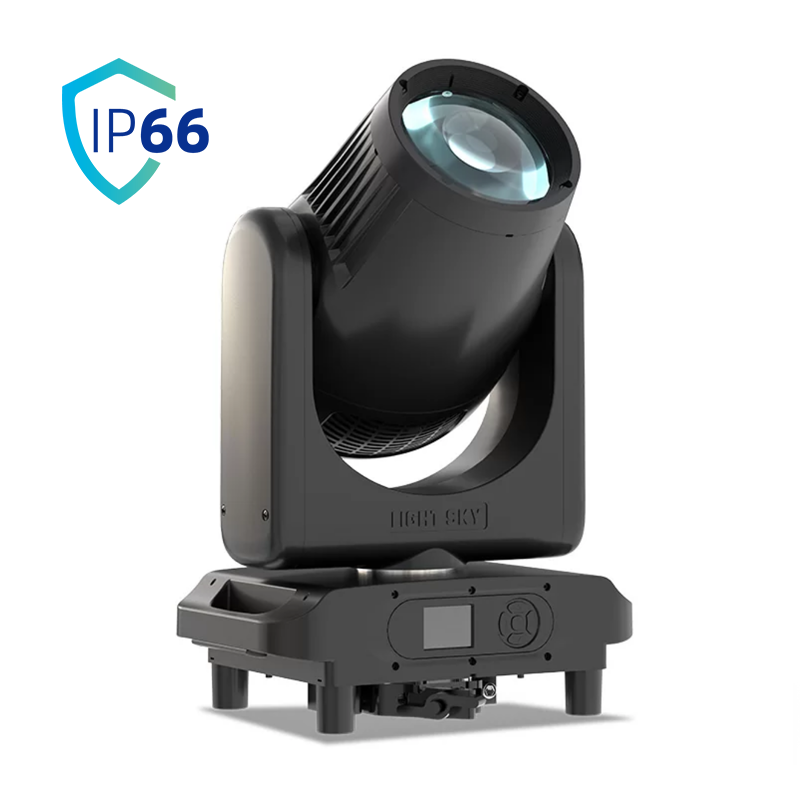
MINI LASER AQUA is designed specifically for outdoor stage and entertainment applications. Its IP66 waterproof construction and output of up to 350,000 lux at 10 meters make it suitable for situations requiring strong long-distance visibility. The fixture should still be installed and operated according to the manufacturer’s environmental and safety requirements.
Weather resistance does not remove the need for thoughtful placement. Drainage, rigging conditions, cable protection, service access, and local weather forecasts remain important parts of an outdoor production plan. Technical preparation supports the creative concept rather than replacing it.
Shaping Athlete Entrances With Direction
Movement across a sports stage is naturally linear: athletes may enter from a tunnel, walk across a field, or gather near a central presentation point. Lighting can reinforce those routes by creating visual connections between different locations.
One useful method is to establish a fixed visual frame first, then introduce moving beams as the athletes approach. This gives the audience a stable reference point before additional movement begins. Excessive fixture motion can dilute the sense of direction, particularly when several entrances occur close together.
Color can add another layer without requiring complicated programming. Neutral white beams may establish anticipation, while controlled color changes can distinguish teams, ceremony segments, or sponsor moments. The key is to maintain a clear relationship between the cue and the event action.
Coordinating Cues With Music And Screens
Music often determines the emotional pace of an entrance, while large LED displays provide another major source of visual information. Lighting should therefore occupy a complementary role rather than compete with either element.
During spoken introductions, quieter lighting can preserve attention for the presenter. Music-driven sections may support sharper beam movement, while a synchronized screen transition can justify a brief change in intensity or direction. Cue sheets become especially useful when several departments must execute the same moment together.
A head beam light system can contribute to these transitions through positioning, intensity changes, and carefully timed movement. Programming should remain readable even when the event contains multiple effects, because spectators need to understand where the important action is taking place.
Conclusion
Memorable sports entrances come from coordination rather than visual excess. Strong beam placement, sensible intensity changes, weather-conscious equipment choices, and carefully timed cues can give athletes a distinctive arrival without turning the entire venue into a constant display of effects. White laser light works particularly well when the creative brief calls for sharp direction and long-distance visibility.
Practical planning remains equally important, especially for outdoor productions where environmental conditions and audience sightlines influence every lighting decision. At LiGHT SKY, we treat those technical factors as part of the creative process, using them to shape lighting systems that support the atmosphere, pacing, and movement of each sports presentation.