Before Choosing AQUAPEARL-MINI for Entertainment Venues: Think About Small-fixture Flexibility
When entertainment venues plan lighting systems, fixture size is only one part of the decision process. The relationship between installation space, visual requirements, control systems, and application flexibility often determines whether a lighting solution can adapt to different productions. At LiGHT SKY, we introduce AQUAPEARL-MINI as a compact lighting option designed for venues that need practical deployment and flexible stage applications. This article explains the key factors to consider when evaluating small fixtures for entertainment environments.
Compact Fixture Design for Flexible Venue Lighting
Venue layouts often include different performance areas, audience distances, and installation limitations. A compact fixture can provide more options when designers need to arrange lighting positions without occupying excessive space.
A small moving fixture is not simply a reduced version of a larger unit. Its value depends on how effectively it balances optical performance, movement capability, and installation convenience. When selecting an LED moving wash, lighting professionals usually consider coverage range, beam adjustment, control compatibility, and the overall role of the fixture within the system.
For entertainment venues such as clubs, theaters, studios, and event spaces, flexible equipment planning allows lighting teams to adjust designs according to different shows. A fixture that supports multiple applications can reduce the need for frequent system changes while maintaining creative control.
Evaluating Coverage and Optical Adjustment Requirements
Lighting design requires careful consideration of how light behaves across different distances and spaces. A fixture with adjustable coverage can help designers create both focused effects and wider illumination depending on the production requirements.
A mini wash light with zoom capability can provide more flexibility than a fixed-angle solution because operators can modify the projected area according to the scene. This adjustment is useful when the same venue hosts different types of events, from smaller performances to larger stage productions.
Optical systems also influence how colors and effects are presented. RGBW LED technology allows lighting designers to combine multiple color channels, while individual LED control can provide additional effect possibilities. These functions should be evaluated based on actual production needs rather than only technical specifications.
Ensuring Precision and Reliability in Entertainment Lighting
Modern entertainment lighting depends on accurate movement and reliable communication between fixtures and control consoles. Pan and tilt functions allow operators to reposition light dynamically, while compatible control protocols help integrate fixtures into existing systems.
For professional venues, lighting equipment needs to work within established workflows. DMX512, RDM, and Art-Net compatibility can support different control environments and provide options for system configuration. Selecting equipment with suitable communication features helps simplify operation and maintenance during events.
Another important factor is operational consistency. Features such as automatic reset with error correction and temperature management can support stable fixture operation when equipment is used regularly in production environments.
Balancing Indoor and Outdoor Application Needs
Entertainment venues may require lighting equipment that can adapt to changing environments. Some projects involve outdoor stages, temporary events, or spaces where equipment may face different environmental conditions.
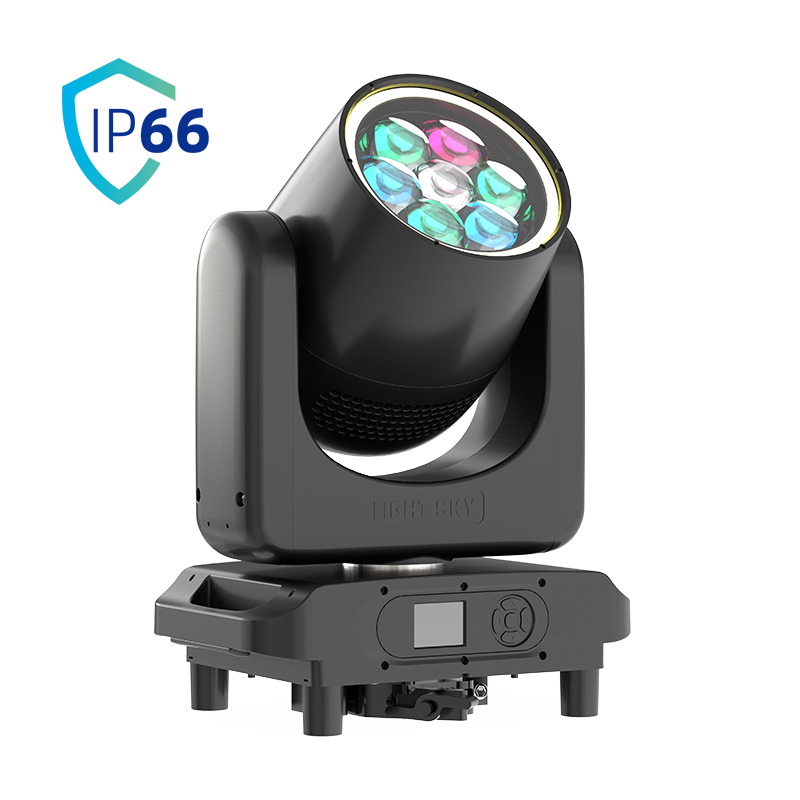
Protection ratings are an important reference when choosing fixtures for these applications. AQUAPEARL-MINI is designed with an IP66 protection rating, allowing it to be used for both indoor and outdoor stage applications. Its compact structure and portability also support scenarios where equipment handling and installation efficiency are important considerations.
However, environmental suitability should always be matched with project conditions. Lighting teams still need to evaluate installation methods, operating requirements, and venue characteristics before building a complete lighting plan.
Planning Small-fixture Flexibility for Future Productions
A venue’s lighting system should not only satisfy current requirements but also support possible changes in programming. Flexible fixtures allow designers to explore different arrangements without completely redesigning the lighting structure.
When selecting a LED moving wash, professionals can review factors such as fixture dimensions, weight, control options, and effect functions. These details influence transportation, installation time, and daily operation efficiency.
Compact equipment can be especially valuable for rental companies and multi-purpose venues because the same fixture may be used across different projects. The goal is not to choose the smallest equipment available, but to select a balanced solution that matches production objectives.
Choosing a Practical Lighting Solution for Entertainment Spaces
For entertainment venues, lighting selection requires a combination of technical evaluation and application planning. A suitable fixture should provide appropriate coverage, reliable control, and convenient integration with existing systems.
At LiGHT SKY, we develop AQUAPEARL-MINI as a compact LED moving head solution featuring RGBW LED sources, zoom adjustment, individual LED control, and a portable structure. It is designed for applications including entertainment venues, concerts, TV studios, festivals, and exhibitions where flexible lighting arrangements are required.
By understanding venue conditions and production goals before equipment selection, lighting professionals can create systems that are easier to manage and adaptable to different performance requirements.