
Achieving Seamless Visual Fades on Curved Setpieces with All-in-One Moving Fixtures
Lighting complex scenic archways requires luminaires that can rapidly shift between razor-sharp profile cuts and soft, atmospheric field washes without interrupting the artistic flow. When lighting designers map intricate physical set structures for outdoor festivals or large-scale theatrical productions, choosing a versatile luminaire like the SUPER SCOPE AQUA, a 520W LED BSWP 4in1 Moving head, determines how cleanly shapes morph along curved surfaces.
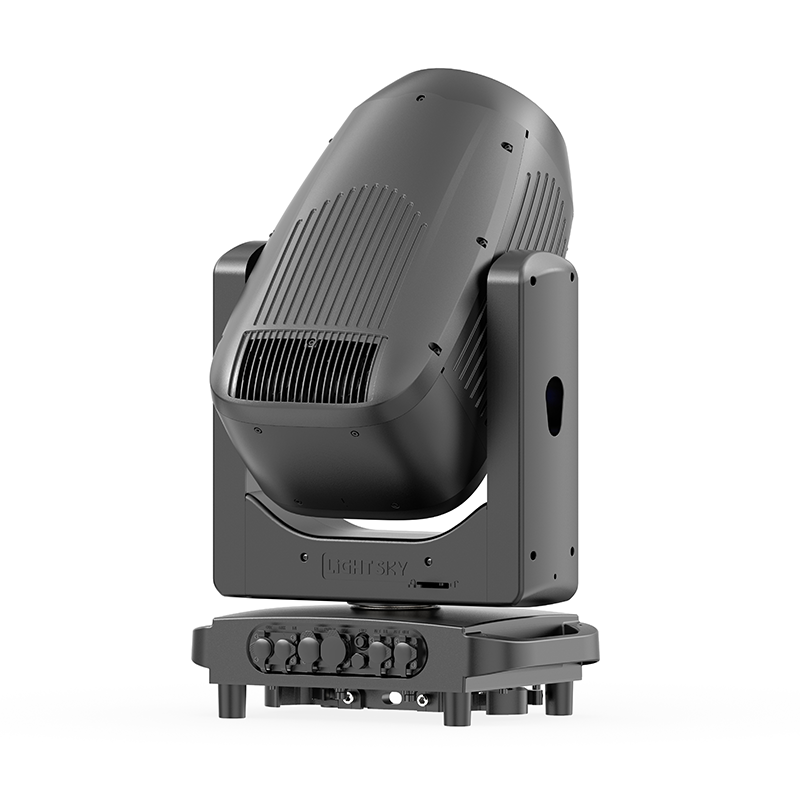
The primary challenge lies in eliminating abrupt transitions when moving from tight aerial cuts to wide background textures across irregular geometries. Solving this requires deep coordination between optical engineering, thermal management, and software-driven dimming control.
Harnessing High-Output LED Engines for Sculptural Arch Projection
Projecting balanced textures onto large scenic arches demands a robust light source capable of maintaining punch over long throw distances without washing out adjacent video elements. We engineer the SUPER SCOPE AQUA around an advanced 520W white LED module that produces a brilliant 34,500 lux output measured at 10 meters, ensuring crisp definition against heavy ambient stage bleed.
Color integrity remains pristine across long operational hours thanks to a high color rendering configuration and infinite CMY color mixing. Lighting directors can cleanly match historical architectural palettes or vibrant modern tour themes without sacrificing overall fixture intensity. This luminous consistency is vital when multiple fixtures overlap to paint a single continuous archway.
Leveraging Wide Zoom Ranges to Morph Beam and Wash Fields
Transitioning a fixture from a tight, linear contour outline into an expansive background flood usually requires swapping lenses or deploying entirely separate units in the rig. Integrating a flexible 3.8° to 50° zoom range allows technicians to execute these dramatic scale shifts natively within a single cue stack.
A narrow 3.8° setting punches out rigid, high-contrast tracing lines that hug the curvature of physical wooden or metal arches. Widening the zoom angle allows the SUPER SCOPE AQUA to cover a larger area, although uniform coverage across curved set pieces depends on fixture placement and the geometry of the surface. This optical versatility significantly reduces rig weight and simplifies address mapping on complex touring riders.
Utilizing Independent Framing Shutters for Sharp Architectural Contouring
It is uncommon for curved architectural components to comply to traditional rectangular projection templates. As a result, accurate edge control is required in order to prevent light leakage onto adjacent LED video walls whenever possible. Programmers are able to carve precise geometric designs by utilising an eight-blade framing shutter module that consists of four independent shutter blades that rotate by plus or minus 90 degrees.
It is possible for automated cues to slide smoothly across angled archways with absolute geometric accuracy because each blade reacts quickly to DMX commands. Additionally, the addition of stacking spinning glass gobos and dual prisms inside the same signal channel results in the creation of complicated breaking patterns that replicate the appearance of stone or flowing textures across the set.
Integrating Smooth Dimming Curves for Gradual Theatrical Fades
The immersive illusion of a theatrical setting that has been expertly illuminated can be readily shattered if there are sudden increases in intensity during sluggish scene changes.
The sophistication of the 16-bit electrical dimming design guarantees that the intensity declines will remain entirely consistent all the way down to the threshold with the least amount of stepping artefacts displayed.
Refining these dimming curves is something that we do at LiGHT SKY primarily for the purpose of supporting broadcast studios and dramatic stage productions, both of which require significantly low-end resolution.
The SUPER SCOPE AQUA supports an adjustable LED refresh rate from 1000 Hz to 25 kHz. Production teams should test the fixture with the intended camera frame rate and shutter settings to assess flicker and rolling-shutter artifacts.
Syncing Multi-Universe DMX Control for Complex Rig Choreography
Executing intricate time-coded sequences across massive set installations demands reliable data routing and rapid feedback protocols. Native support for Art-Net and sACN networking standards allows technicians to daisy-chain data lines efficiently through rugged locking ethernet connectors.
Built-in RDM functionality streamlines remote addressing and diagnostic monitoring, letting lighting operators check fixture health directly from front-of-house consoles. This seamless network integration eliminates signal bottlenecks during high-pressure cue stacks on fast-paced touring schedules.
Maintaining Outdoor Environmental Resilience on Complex Stage Builds
Open-air architectural installations and festival stages expose lighting inventories to sudden weather shifts, dust, and heavy moisture that can compromise internal electronics. Built inside a durable chassis with an IP66 protection rating, the unit safeguards its delicate optics and motorized systems against driving rain and atmospheric debris.
Intelligent thermal control sensors actively regulate internal cooling fans, keeping noise levels low while protecting the LED engine during extended high-output sequences. Technical crews rely on this rugged build quality to execute ambitious outdoor scenic designs with complete operational peace of mind.
Mastering visual transitions across complex scenic architecture depends on unified optical control, precise shutter framing, and dependable environmental engineering. By selecting multi-functional luminaires—such as spot moving heads—that merge spot, wash, and profile capabilities into a single housing, production teams achieve fluid, professional results on every show.