A Cleaner, Simpler Lighting Plan for Panel Discussion Stages With a 4-in-1 Profile Moving Head
Panel discussions depend on visual clarity rather than constant spectacle, yet the lighting still needs enough variation to separate speakers, presentation areas, and transitional moments. Beam spot wash profile concepts can help planners build those layers without turning every cue into a dramatic effect. At LiGHT SKY, we view this kind of production as an exercise in balance: the audience should notice the people and ideas first, while the lighting quietly establishes depth, focus, and atmosphere around them.
Establishing Clear Visual Zones
Panel stages often contain several functional areas: a central discussion desk, individual seats, presentation screens, and sometimes a standing area for moderators or guests. Treating each zone independently makes the overall design easier to manage. Rather than flooding the entire stage with identical illumination, designers can assign different intensities and angles according to how each area is used.
A useful approach is to begin with facial visibility, then build surrounding layers around it. Speakers require consistent front or side illumination, while scenic elements can receive softer treatment. This distinction prevents the background from competing with the people on stage.
The principle behind beam spot wash profile is especially useful when several visual tasks need to coexist. Narrower projection can add structure behind a speaker, broader coverage can soften an architectural backdrop, and shaped light can visually define a presentation position. Each layer serves a different purpose instead of relying on brightness alone.
Managing Light Around Screens
Large LED walls and projection surfaces introduce another challenge: excessive illumination can reduce perceived screen contrast. A well-planned lighting system therefore considers the relationship between fixture angles, screen position, camera viewpoints, and audience sightlines before programming begins.
Camera work deserves particular attention during conferences. A light level that looks comfortable from the audience may appear harsh through a broadcast camera. Subtle changes in intensity and color temperature can help maintain consistent skin tones while keeping presentation graphics readable.
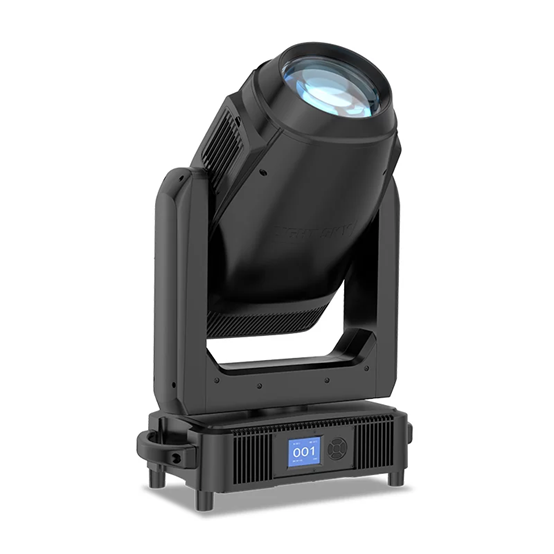
The LED BSWP 4-in-1 moving head spotlight offers one practical example of how several lighting functions can be consolidated within a single fixture. The SUPER SCOPE PLUS combines beam, spot, wash, and profile functions, while its 180 mm precision lens supports defined projection. Its two rotating gobo wheels provide interchangeable pattern options, and the four-blade framing system allows controlled shaping when a clean-edged projection is needed. Because this model is intended for indoor professional applications, it fits venues such as theaters, studios, conferences, and other enclosed event spaces.
Building Depth Without Visual Clutter
Depth does not always require dramatic movement. A restrained change in intensity behind the panel can make a relatively flat stage feel more dimensional, particularly when the set contains dark surfaces or architectural structures.
Color also has a role in separating visual planes. Neutral or slightly cooler tones may work well around presentation areas, while warmer accents can help distinguish a discussion zone. The important point is consistency: abrupt color changes should have a reason connected to the program rather than appearing simply because the fixture offers numerous effects.
Another useful technique is controlled projection. Gobo patterns, framing, and prism effects can create texture during walk-on moments or transitions, then disappear when discussion resumes. This keeps the main conversation visually dominant while still giving the production enough flexibility to change character between segments.
Making Cue Changes Easier to Follow
Panel discussions frequently move between introductions, keynote remarks, audience questions, demonstrations, and closing statements. Lighting cues become easier to understand when each state has a clear visual purpose.
A basic discussion look might prioritize even facial coverage. A presentation cue could introduce stronger separation around the screen or speaker position. During transitions, a wider wash or subtle background change may signal that the program is moving into another section without requiring an elaborate sequence.
Here, beam spot wash profile thinking becomes a programming strategy rather than merely a fixture description. Each lighting function can correspond to a specific stage requirement, allowing operators to build logical cue groups instead of creating unrelated looks one by one.
Consistency also matters when several operators or technicians work on the same production. Clear naming conventions, documented positions, and restrained effect choices make the lighting plot easier to understand during rehearsals and live operation.
Keeping Effects Purposeful
We believe visual effects can add interest to panel environments, but restraint usually delivers a more professional result. We find fast movement, heavy prism effects, or highly saturated colors can distract audiences from serious discussions if left active during speaking segments.
A better moment for stronger effects is often the transition between program sections. Short bursts of texture can accompany walk-on music, sponsor segments, award moments, or opening sequences. Once the conversation begins, those effects can retreat into the background.
The second principle worth considering is flexibility. A fixture that can perform several optical roles may reduce the number of different fixture types required in a compact rig, while still allowing designers to create distinct looks. This does not mean every function must appear in every cue; versatility becomes useful precisely because the operator can choose what not to use.
Conclusion
Thoughtful conference lighting is less about filling every available space with illumination and more about giving each part of the stage a clear visual role. LED BSWP 4-in-1 moving head spotlight technology can support that approach when its optical functions are assigned according to the needs of the program rather than used indiscriminately. For panel stages, controlled framing, measured color changes, selective texture, and consistent speaker coverage can create a polished environment without overwhelming the discussion. At LiGHT SKY, we apply this practical perspective when developing professional stage lighting solutions. We tie flexibility to real‑world production requirements instead of treating effects as mere decoration.